Does this book fulfill prophecy?
I think my recent book Francis Bacon and the Heroic Archetype: The Greatest Story Never Told fulfills the prophecy in Daniel 8. It needs a revision, but it was a huge effort to get this far, even with help.
And in the latter time of their kingdom, when the transgressors are come to the full, a king of fierce countenance, and understanding dark sentences, shall stand up.
“Understanding dark sentences” fits the chapter on Bacon and Esotericism; more generally, my work on alchemy. Alchemy is drug-based mysticism, and most likely originates with Daoists around 200 BC. They were being persecuted (remember Leo Strauss, Pesecution and the Art of Writing, persecution can produce esoteric writing) and they had a lot of shamanic traditions, so they invented this coded language and it migrated West pretty rapidly with trade traffic. They want to say Alexandria, I think because Jews lived there, and they have to own everything. But no, the Chinese and Indian texts are much more overt, it clearly became more obscure as it moved West, especially in Europe, with the church.
I should explain this to you, in alchemy, mercury is the mind, because it’s fluid and it reflects its surroundings; salt, being a cube, is the physical principle, and sulfur is energy, because of the bright yellow solar color.
And his power shall be mighty, but not by his own power: and he shall destroy wonderfully, and shall prosper, and practise, and shall destroy the mighty and the holy people.
This is true, Peter Theil called me “the philosopher to end all philosophers.” It’s a nice compliment, but coming from that source, ehh… We’re still waiting on the prosperity part. But yeah, the book will just wipe out whole segments of academia. Not my fault, dude, I’m just trying to get to the truth. You guys need some truth. “Destroy the mighty and holy people,” because Bacon is verboten in Judaism and Islam, and it’s a new version of the hero archetype, one based on the acquisition of knowledge and wisdom. A hero not of might, but of the mind. If you really want to dig into Bacon’s store of knowledge, The Anatomy of Melancholy is your book.
You might object that Bacon cannot have written so much, in addition to his other work, but prolific authors are sometimes very prolific. P.G. Wodehouse comes to mind, he wrote something like a hundred books, many of which were plotted in 30,000 word outlines before he even started writing. So you could say he wrote 150 books, in addition to dozens of plays. So that’s well beyond the range claimed for Bacon, it just so happens that many of Bacon’s books were so consequential. Wodehouse and Bacon, and T.S. Eliot—those are the guys, if you want to spoil yourself.
And through his policy also he shall cause craft to prosper in his hand; and he shall magnify himself in his heart, and by peace shall destroy many: he shall also stand up against the Prince of princes; but he shall be broken without hand. And the vision of the evening and the morning which was told is true: wherefore shut thou up the vision; for it shall be for many days.
It’s true, partly because I have been brought so low, I have puffed myself up at times. And I was brought low, I was broken without hand long ago. “The Prince of princes” could be Machiavelli, I’m trying to banish Machiavelli, the book has a long chapter and a long appendix in that direction. That’s an interesting question, if Machiavelli is in the book of Daniel, eh? Not beyond the power of God, not at all.
But yeah, I’m sorry about this, but if you want to preserve your civilization, just take a look.
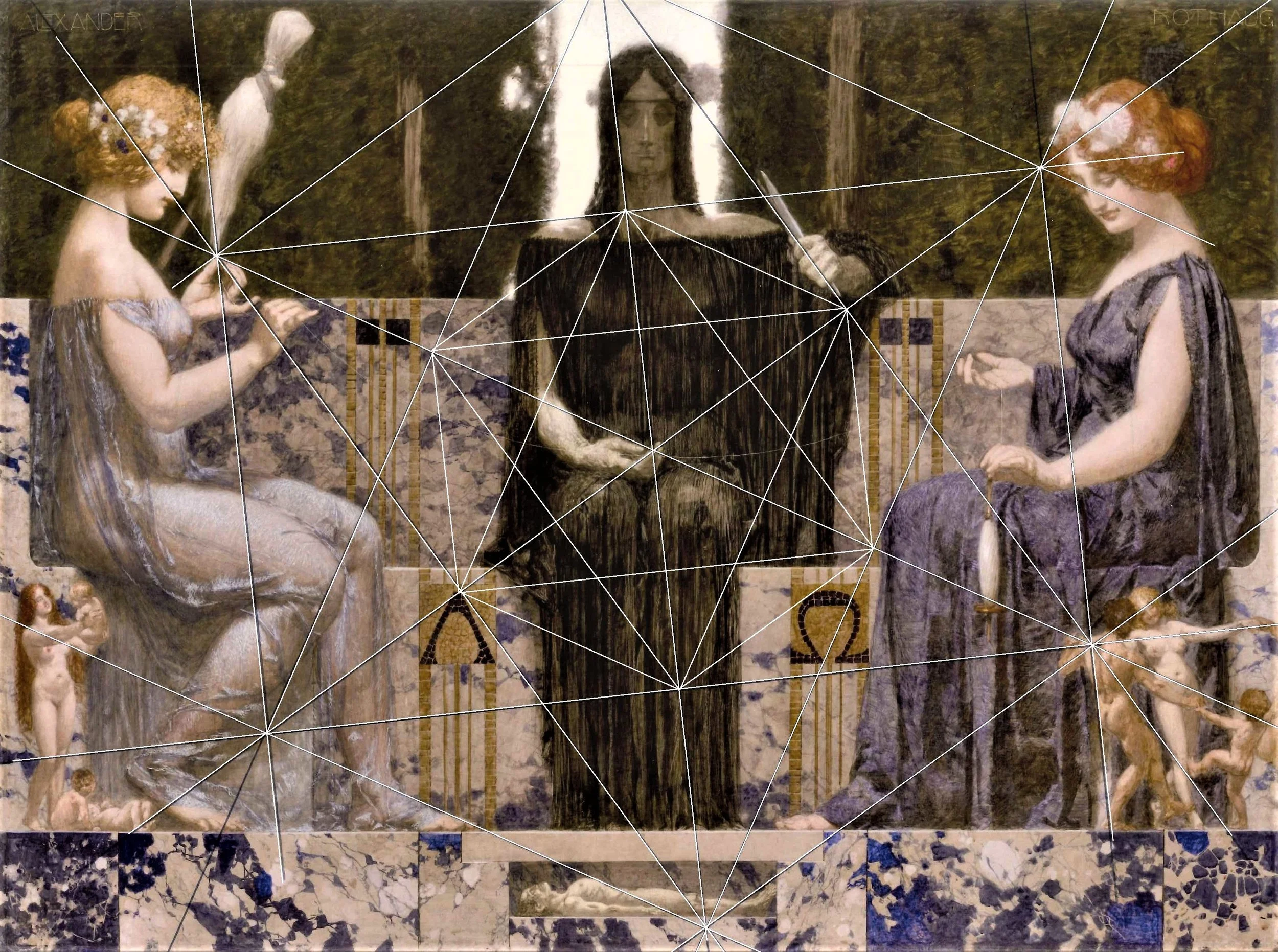
Alexander Rothaug, Three Fates, 1910