Mysticism
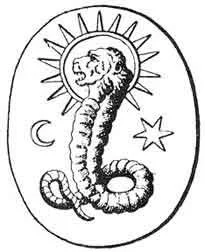
Graeco-Roman gnostic amulet
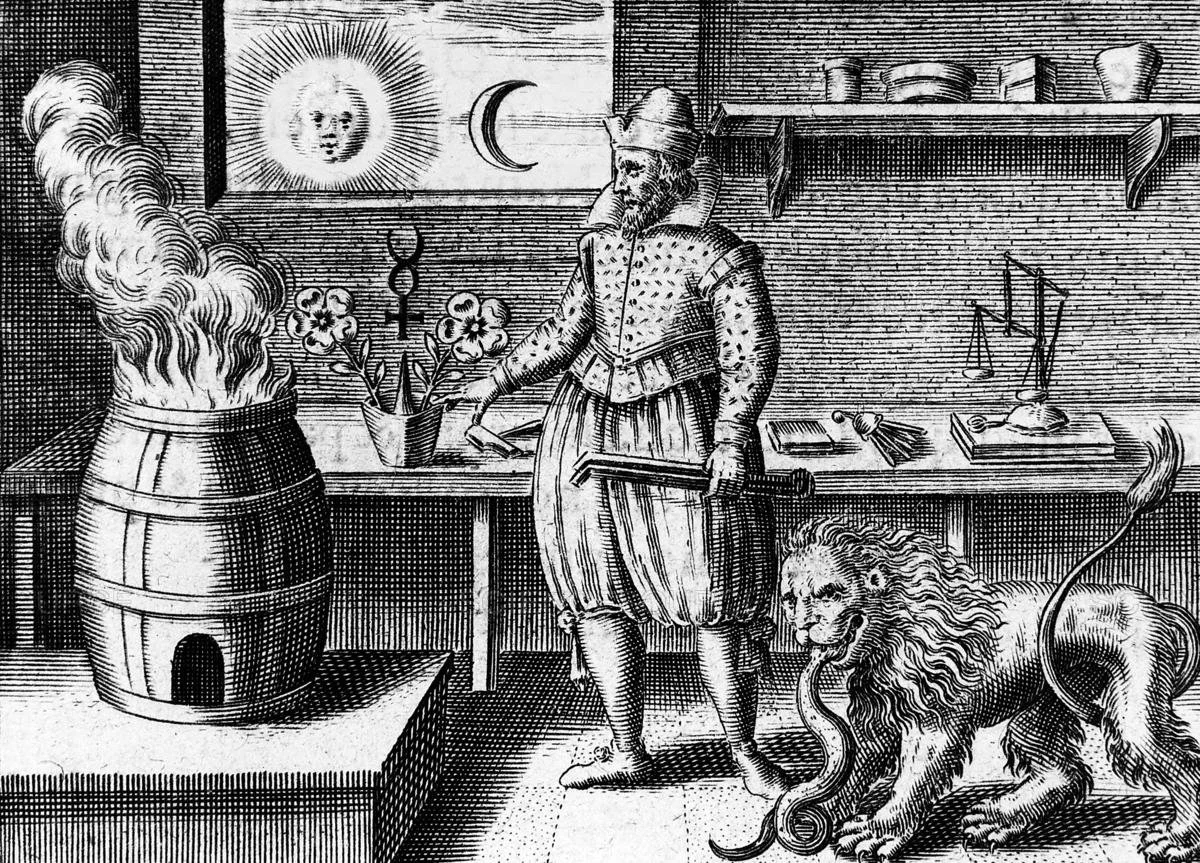
Twelve Keys of Basil Valentine, 1599
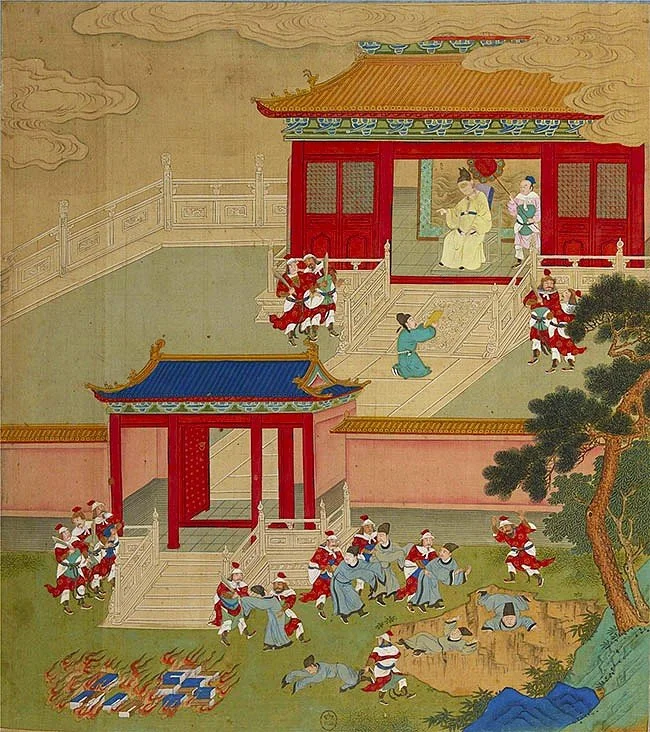
One one level, then, Cain and Abel can be read as state and church. A good example is the English Reformation, when Henry VIII declared himself head of the church and seized all the monasteries. Another example was the “burning of books and burying of scholars” that occurred in 213-212 BC, during the consolidation of China after the Warring States period. The state favored the philosophy of Legalism, which stressed state power; competing schools, notably Confucianism and Taoism, were suppressed.
In truth, much of Bacon’s life was passed in a visionary world, amidst things as strange as any that are described in the Arabian Tales, or in those romances on which the curate and barber of Don Quixote’s village performed so cruel an auto-da-fe, amidst buildings more sumptuous than the palace of Aladdin, fountains more wonderful than the golden water of Parizade, conveyances more rapid than the hippogryph of Ruggiero, arms more formidable than the lance of Astolfo, remedies more efficacious than the balsam of Fierabras.
—Thomas Babington Macaulay, “Lord Bacon”
The story of Cain and Abel has an interesting parallel with the Roman myth of Romulus and Remus. In both narratives, a fratricide, occasioned by a dispute regarding God or the gods, precedes the founding of a city. Cain works the earth and founds the first city, so he is associated with agriculture, while Abel is associated with shepherding and older nomadic life. One possible reading relates to the change in religion that occurs with the introduction of agriculture and the development of stable, large-scale civilization. Previously confined to small-scale shamanism, religion becomes the central organizing principle of society. It becomes institutionalized and ossifies, losing its direct connection to the divine, apart from revelation. This theme is present in the Mesopotamian epic of Gilgamesh, the oldest surviving written story:
Gilgamesh's quest for the plant of immortality may hide an idealized memory of, and nostalgia for, abandoned shamanic drug plants... Is the plant they seek, in reality, the drug plant with which their shamanic predecessors had 'attained immortality', that is, seen the things of heaven? Such myths seem to signal the end of the free performance of the shamanic rite, and the inculcation of a new ethic of subservience to the state... There are a number of Mesopotamian myths that show a concern about the inability of human beings to fly, alongside those that show anxiety about the inaccessibility of a plant with special powers. It might be anxiety over the loss of the shamanic performance, and the drug plant used in it, that these myths record.
Thomas McEvilley, The Shape of Ancient Thought: Comparative Studies in Greek and Indian Philosophies
Third eye exercise
Eliot’s Four Quartets is strongly influenced by Eastern and Presocratic philosophy; it opens with a fragment from Heraclitus, “Although logos is common to all, most men live as if they had a wisdom of their own.” Eliot was great with imagery, raising the mind’s eye to the divine.
“He who is greatest among you shall be your servant. And whosoever shall exalt himself shall be abased; and he that shall humble himself shall be exalted.” This teaching of Jesus is actually prefigured centuries earlier in the I Ching, “To rule truly is to serve.”

Ripley scroll, 15th century
The Sufis

Killing the Scholars and Burning the Books, anonymous 18th century Chinese painted album leaf
East and West
I have a pet theory about the East and West being like the earth's right and left brain hemispheres. I started thinking along these lines after noticing that Eastern languages are often pictorial. It was the West's role to conquer and subdue the earth, so we have favored a more left-brain paradigm. Western religion has emphasized belief and worship, in contrast to the East, where yoga means “union with God.” The left brain/right brain idea fell out of favor, but has returned in modified form, particularly in the work of Iain McGilchrist.
Dropbox file with examples of grids used in paintings:
https://www.dropbox.com/sh/15peqzgebsok8zy/AAAXy4W00NuipnfgD3s-q6xva?dl=0
I found that this is an excellent way to develop inner consciousness or the third eye. There are two invisible levels, the astral and celestial; Jesus said “Except a man be born again, he cannot see the kingdom of God”; “If your eye is single, your body will be full of light.” This refers to the mind’s eye or third eye, the inner consciousness, which opens first to the astral level, then the celestial, the heavenly level.

Japan’s laughing mushrooms
Long, long ago, some woodcutters from Kyoto went into the Kitayama mountains and lost their way. Not knowing which way to go, four or five of them were lamenting their condition when they heard a group of people coming from the depths of the mountains. The woodcutters were wondering suspiciously what sort of people it might be when four or five Buddhist nuns came out dancing and singing. Seeing them, the woodcutters became fearful, thinking things like, “Dancing, singing nuns are certainly not human beings but must be goblins or demons.” And when the nuns saw the men and started straight toward them, the woodcutters became very frightened and wondered, “How is it that nuns come thus out of the very depths of the mountains dancing and singing!”
The nuns then said, “Our appearance dancing and singing has no doubt frightened you. But we are simply nuns who live nearby. We came to pick flowers as offerings to Buddha, but after we had all entered the hills together we lost our way and couldn’t remember how to get out. Then we came upon some mushrooms, and although we wondered whether we might not be poisoned if we ate them, we were hungry and decided it was better to pick them than to starve to death. But after we had picked and roasted them we found they were quite delicious, and thinking, “Aren’t these fine!” we ate them. But then as we finished the mushrooms we found we couldn’t keep from dancing. Even as we were thinking, “How strange! strangely enough we…“ The woodcutters were no end surprised at this unusual story.
But the woodcutters were very hungry so they thought, “Better than dying let’s ask for some too.” And they ate some of the numerous mushrooms that the nuns had picked, whereupon they also were compelled to dance. In that condition the nuns and the woodcutters laughed and danced round and round together. After a while the intoxication seemed to wear off and somehow they all found their separate ways home. After this the mushrooms came to be called maitake, dancing mushrooms.
When we think about it this is a striking story. For even though we still have this kind of mushroom, people who eat them do not dance. Thus this exceedingly strange story has been handed down.
Sanford, James H. “Japan’s Laughing Mushrooms” Economic Botany Vol. 26, No. 2 (Apr. - Jun. 1972), pp. 174-181
Exercises
You need to absorb material that comes from higher intelligence, by exposing yourself to literature, art, and music that comes from higher intelligence.
There is an exercise I'm going to nick from Maimonides, which I didn't know about back when I was doing my spiritual work, but seems like a good one. It is very simple, you just hold the idea of God in your mind at various times throughout the day.
There is an exercise where you imagine a connection between your heart and mind; you can even feel a little jolt of energy with this.
There is a meditation where you sit comfortably in a chair, and concentrate your attention on sensing a particular part of your body. Just sense your left foot, then the right, and move up through the rest of your body.
There is an exercise where you extend your arms horizontally, as long as you can, while holding the idea "I AM" in your mind.
There is an exercise where you try to stop thinking by brute force. This is somewhat similar to mantras and one-pointed meditation.
You can do cold showers and mild fasting.
Volunteering is something I would recommend. Of all that I did, I think volunteering was the most profitable, in terms of development. I worked at animal shelters, the botanical gardens, and a nursing home—the nature of the work is not important.
Our intellectual paradigm has been distorted by colonialism, particularly the Civilizing Mission of British colonialism. This has resulted in a false dichotomy between the "rational" West and the "superstitious, backward" East. It's interesting to note that the tools which enabled the West to conquer the earth, gunpowder, moveable type, and the magnetic compass, were actually invented earlier in China. In the East, enlightenment is seen in spiritual terms, but this is how Immanuel Kant famously defined it:
Enlightenment is man's emergence from his self-imposed immaturity. Immaturity is the inability to use one’s understanding without guidance from another. This immaturity is self-imposed when its cause lies not in lack of understanding, but in lack of resolve and courage to use it without guidance from another. Sapere Aude! “Have courage to use your own understanding!”—that is the motto of enlightenment.
There is an old debate within Hindu philosophy concerning the relative superiority of bhakti yoga, the yoga of devotion or the heart, and jnana yoga, the yoga of knowledge or wisdom (pronounced gnāna, with a hard g). Devotion has usually been accorded pride of place: love, surrender, and grace appear warmer, more humane, and more spiritually attractive than intellectual discrimination. Yet jnana yoga has at least this much to be said in its favor: even if one falls short of full union with God, one does not fail altogether. Knowledge refines the mind, disciplines perception, and leaves the practitioner wiser, more capable, and more useful to the world.
A remarkable passage, often attributed to Francis Bacon, seems to display an implicit understanding of precisely this division of spiritual paths:
By us doth the Bridegroom offer thee a choice between four ways, all of which, if thou dost not sink down in the way, can bring thee to his royal court. The first is short but dangerous, and one which will lead thee into rocky places, through which it will be scarcely possible to pass. The second is longer, and takes thee circuitously; it is plain and easy, if by the help of the Magnet thou turnest neither to left nor right. The third is that truly royal way which, through various pleasures and pageants of our King, affords thee a joyful journey; but this so far has scarcely been allotted to one in a thousand. By the fourth shall no man reach the place, because it is a consuming way, practicable only for incorruptible bodies.
This passage, found in The Chymical Wedding of Christian Rosenkreutz (1616), is among the strongest and most intriguing parallels to Indian spiritual classifications that one can cite. Unlike many Baconian attributions, it does not depend on fragile verbal resemblance or clever wordplay. It rests instead on something far more difficult to counterfeit: structural knowledge. What is being displayed here is an understanding of how spiritual paths are distinguished, ranked, and psychologically evaluated, not merely named.
The Hindu framing itself is well established. Classical Indian traditions, especially as later systematized in Yoga and Vedānta, distinguish among physical austerity (tapas), devotion (bhakti), knowledge (jnana), and selfless action (karma). Asceticism promises speed but courts danger; devotion is safer and more accessible, though slower; knowledge is rare, demanding, and royal; and certain transformative paths involving the body itself are reserved for the few and are perilous in the extreme. Crucially, jnana yoga is often regarded as inferior in warmth but superior in resilience: when devotion falters, knowledge still yields insight and benefit.
What makes the passage from the Chymical Wedding extraordinary is not the mere enumeration of “four ways,” but the manner in which each is evaluated. The first path, associated with physical austerities, is described as short but dangerous, leading through rocky places scarcely passable. This is a textbook assessment of asceticism in Indian literature: rapid results, severe risks, bodily damage, and the temptation to spiritual pride. Medieval Christian writing, by contrast, tends far more often to glorify austerity than to warn so explicitly against it.
The second path is longer and circuitous but plain and easy, provided one follows the guidance of the “Magnet.” This language closely resembles the ethos of bhakti: attraction rather than force, love rather than strain, progress guided by a pull toward the divine. The image of the magnet is especially telling. In devotional traditions, God draws the soul; salvation is less a conquest than a response. That imagery sits more comfortably within Indian devotion than within the dominant categories of scholastic Christianity.
The third path, explicitly called “the truly royal way,” is the way of knowledge. It is joyful, adorned with pleasures and pageants, but reserved for the few: “scarcely allotted to one in a thousand.” This description aligns uncannily with classical jnana yoga, which is repeatedly characterized as kingly, rare, demanding of inner maturity, luminous rather than punitive, and capable of producing joy rather than dryness. Most strikingly, knowledge here is neither cold nor merely corrective; it is celebratory. Medieval European thought typically opposed intellect to love or subordinated it to doctrinal correctness. This passage instead harmonizes insight and delight.
The fourth way is a consuming path of fire, practicable only for incorruptible bodies. Here the language turns alchemical, but the parallel extends further. Traditions of bodily transformation, whether in alchemy, Tantra, or Vajrayāna Buddhism, promise liberation through transmutation of the embodied self. They are also notorious for their dangers: failure is not merely disappointing but catastrophic. Once again, the evaluative framing is precise rather than rhetorical.
Such knowledge could, in principle, have reached Europe by the late sixteenth and early seventeenth centuries. Jesuit reports from India were circulating; Persian and Arabic traditions had already absorbed and reframed Indian yogic ideas; Neoplatonic, Hermetic, and Sufi currents had translated Eastern distinctions into Western idiom; and alchemy functioned as a universal symbolic language of transformation. Transmission is therefore possible, but what is implied here is not casual borrowing. It is deep synthesis.
While it is tempting to attribute the resemblance between the Chymical Wedding’s “four ways” and Eastern yogic paths purely to universal archetypes, there is good reason to consider historical transmission routes. The parallels are too structurally intricate to be dismissed as mere coincidence. In fact, there is a long and complex history of philosophical and mystical ideas traveling between East and West. As early as the Presocratics, thinkers were influenced by ideas that had made their way from India through the Persian Empire. During the era when both Anatolia and India were part of the Persian Empire, cross-cultural exchange was not just possible but inevitable. Later, the Hellenistic period and the spread of Neoplatonism also saw Eastern metaphysical concepts weaving into the Western philosophical fabric. The Crusades, too, facilitated a renewed exchange of ideas. Islamic scholars had preserved and expanded upon ancient philosophical traditions, and their works re-entered Europe along with a broader influx of mystical and hermetic knowledge. Hermeticism itself is a blend of Greek, Egyptian, and possibly even Eastern influences, and it became a vessel for transmitting and reshaping these ideas in the Renaissance.
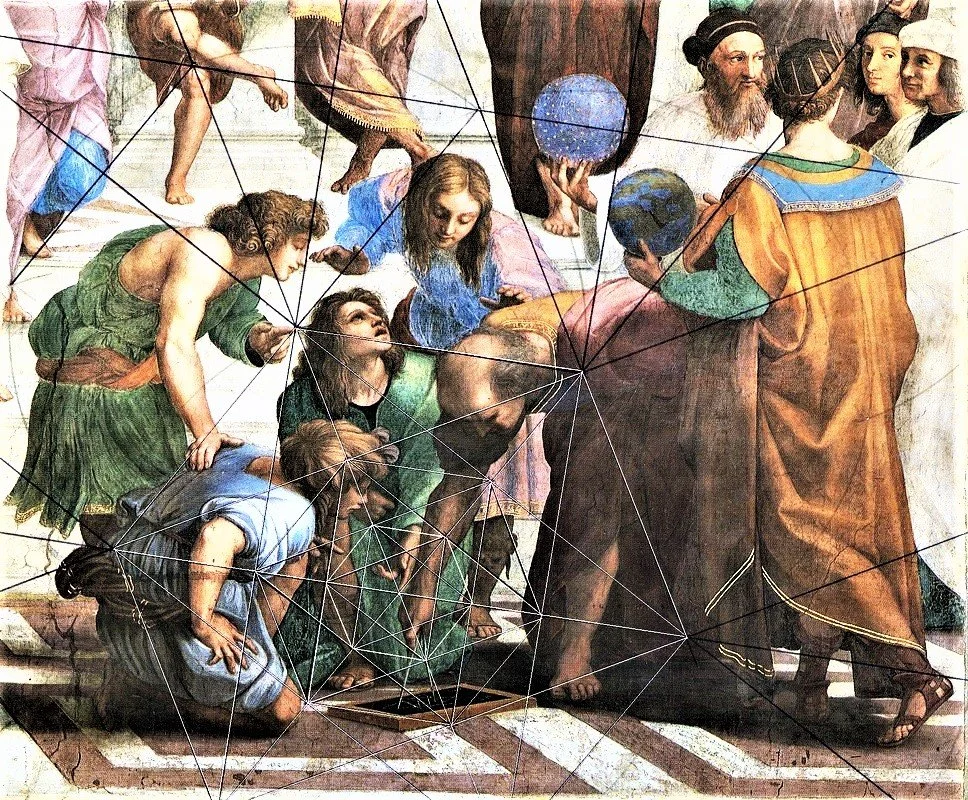
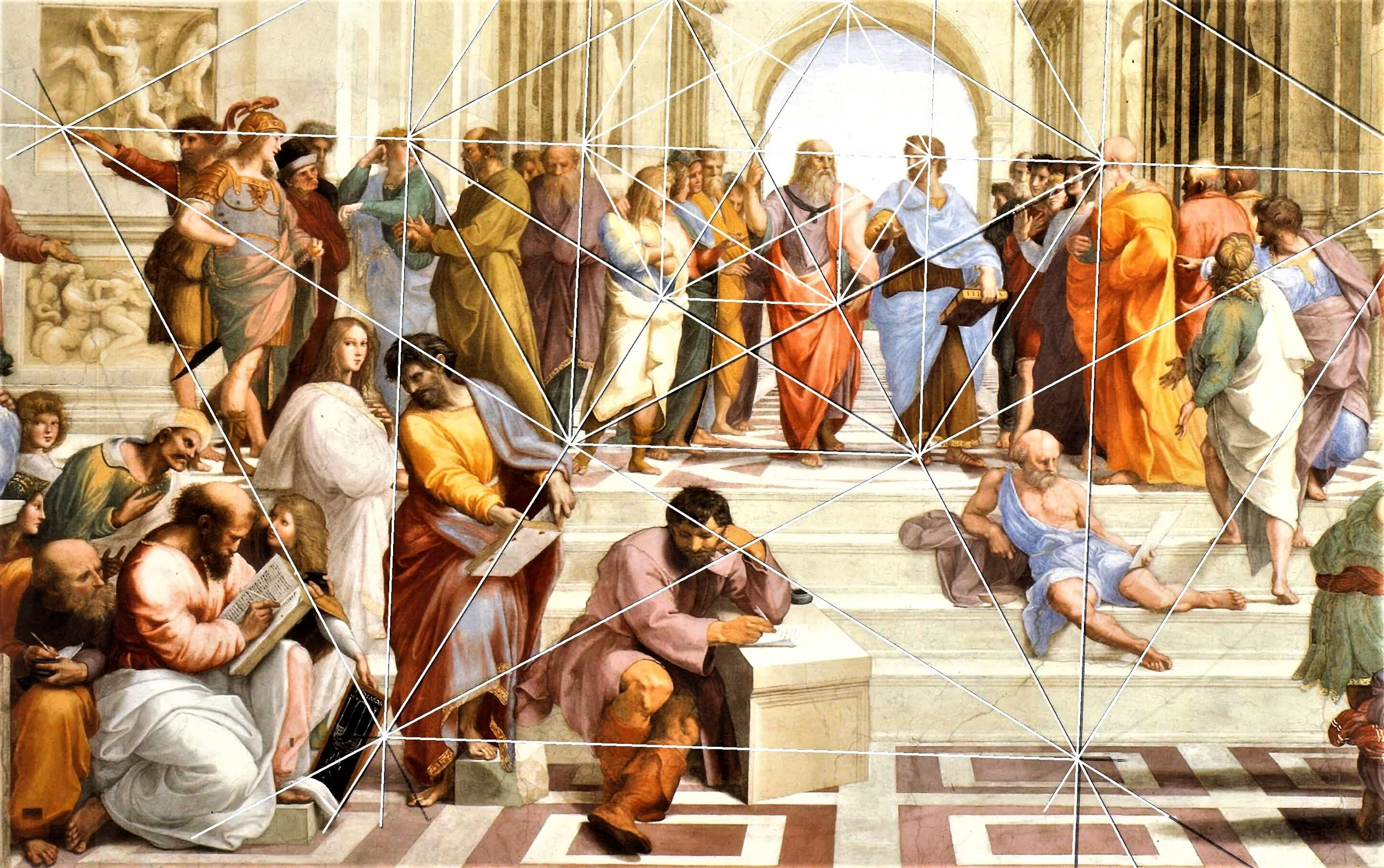
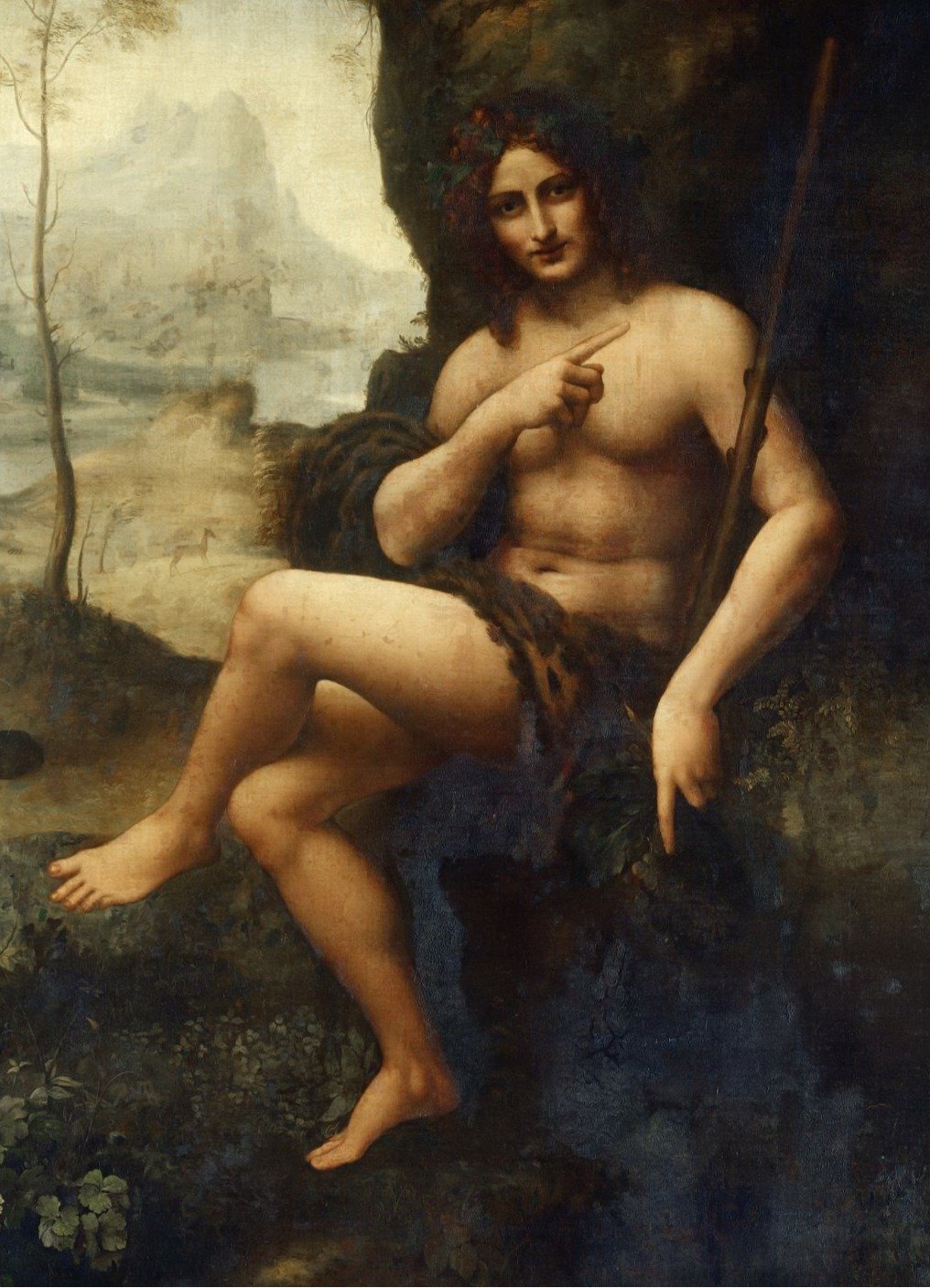
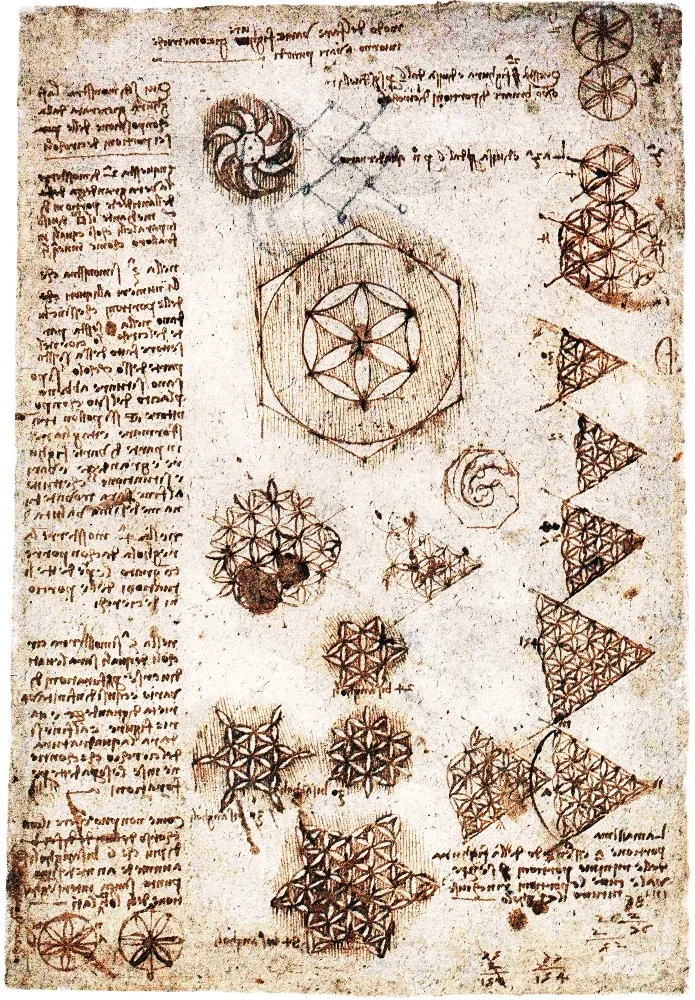
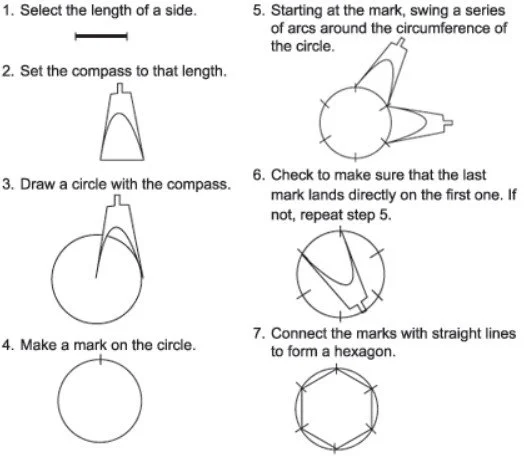
This is Raphael’s School of Athens. Plato is standing center-right, pointing upward; as you may recall, over the door of his Academy a sign read: “Let no one ignorant of geometry enter.” His theory of forms posits that physical reality is an imperfect and changing copy of a higher, eternal, and immutable realm of abstract entities called “Forms” or “Ideas.” These ideal models (beauty, justice, geometric shapes) are the true essence of things and can only be known through reason and the mind’s eye, not the senses. If you draw a hexagon grid using a compass, using Plato and the man pointing in the upper-left as starting points, the emerging grid aligns perfectly. I first discovered this phenomenon in 2005, when I saw Leonardo’s Bacchus and thought it looked intentionally awkward, pointing with both hands. Geometry was a natural guess.

Ben Jonson’s The Alchemist (1610)
Ch’eng Wei tried to make gold according to the directions of the Vast Treasure in the Pillow. He was unsuccessful, and his wife, going to look at him, found him just fanning the ashes in order to heat the retort. In the retort was some quicksilver. She said: “Just let me see what I can do,” and from her pocket produced a drug, a small quantity of which she threw into the retort. A very short while afterwards she took the retort out of the furnace, and there was solid silver all complete!
—Ko Hung, Pao P'u Tzu
Once the floriate elixir is finished, one ounce constitutes a “transcendent dose.” If one wishes to remain in the mundane world, half an ounce is sufficient. . . The fruit of this tree will be ring shaped. Its name is the Tree of Ringed Adamant. Eating its fruit causes you to be born together with the heavens and rise up to the Grand Bourne, your form transformed into clouds.
—The Upper Scripture of Purple Texts Inscribed by Spirits
Xianke said, “We have numinous herbs and can only practice flying steps. Today the whole household is secluded in the rear mountains and further cultivates Taoist methods. As for the matter of direct ascension, how could I have expectations therein? We only have long life and that is all.”
—Sun Guanxian, Beimeng suoyan
It was after this discourse that the Son of Heaven for the first time performed in person the sacrifices of the furnace... He occupied himself in experiments with powdered cinnabar, and all sorts of drugs, in order that he might obtain gold.
—Ssu-ma Ch-ien, Historical Memoirs
The way to make oneself a Fo Shih Hsien [a drug-using supernatural being] lies in the use of drugs of a nature similar to oneself.
—Ts'an T'ung Ch'i
[T]here is much reason for thinking that the ancient Taoists experimented systematically with hallucinogenic smokes, using techniques which arose directly out of liturgical observance… At all events the incense-burner remained the centre of changes and transformations associated with worship, sacrifice, ascending perfume of sweet savour, fire, combustion, disintegration, transformation, vision, communication with spiritual beings, and assurances of immortality. Wai tan and nei tan met around the incense-burner. Might one not indeed think of it as their point of origin?
—Joseph Needham, Science and Civilization in China
Our true and real Matter is only a vapor... This Green Dragon is the natural Gold of the Philosophers, exceedingly different from the vulgar, which is corporeal and dead... but ours is spiritual, and living... Our Gold is called Natural, because it is not to be made by Art, and since it is known to none, but the true Disciples of Hermes, who understand how to separate it from its original Lump, tis also called Philosophical; and if God had not been so gracious, as to create this first Chaos to our hand, all our Skill and Art in the Construction of the great Elixir would be in vain.
Baron Urbigerus, Aphorismi Urbigerani
Metals, as above stated, contain a salt, out of which fire and the sagacity of the artist can educe a water, which the Sages call Mercurial water, the Virgin's milk, Lunaria, May dew, the Green Lion, the Dragon, the Fire of the Sages... This is the hidden and incomparable treasure of all the Sages, which none can obtain except through the teachings of a Master, or by revelation of God, who, in His goodness makes it known to whom He will.
—The Theatre of Terrestrial Astronomy
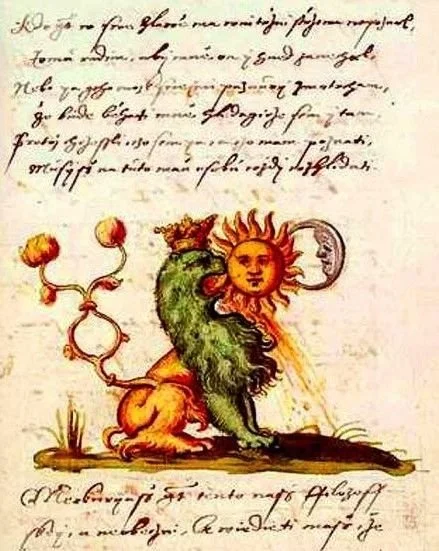
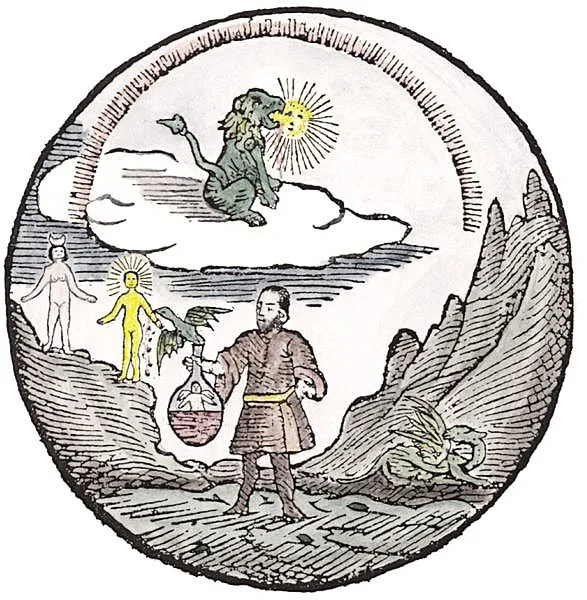
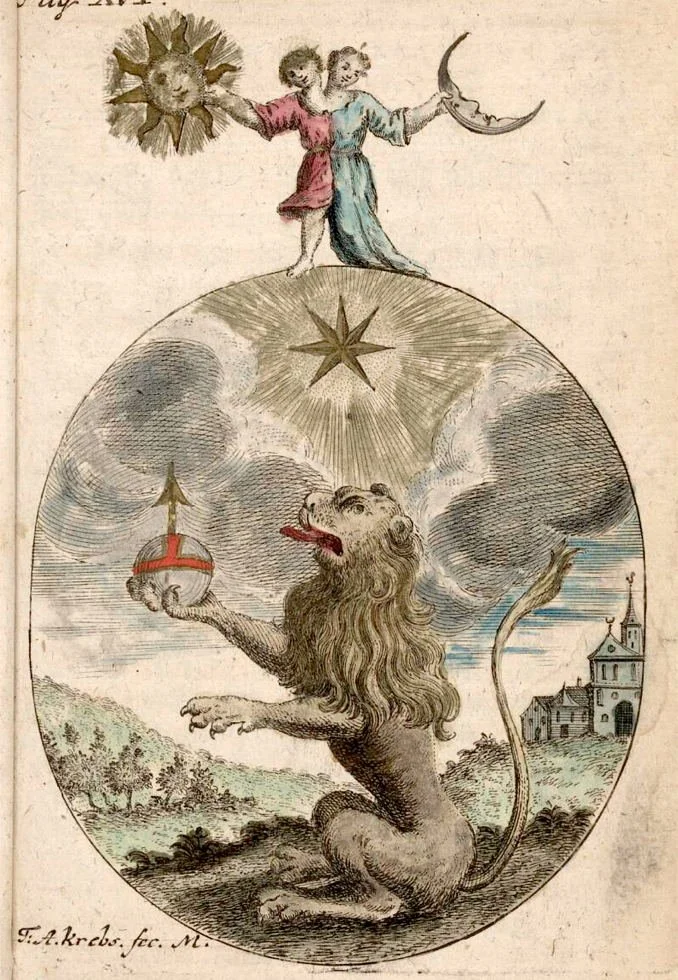
Moreover the Lion is said to be green in the threefold aspect. First in respect of his attractive power, for here the Central Sun is like to the Celestial Sun and makes the world flourishing and green. Secondly, it is called the green Lion, because as yet the Gold is incomplete, nor fixed in any body, and therefore is called living Gold. Thirdly, it is called a Lion by reason of its very great strength, reference being had to the Animal Lion, for as all beasts obey the lion, so all metallic bodies do give place to this living Gold.
—The Crowning of Nature
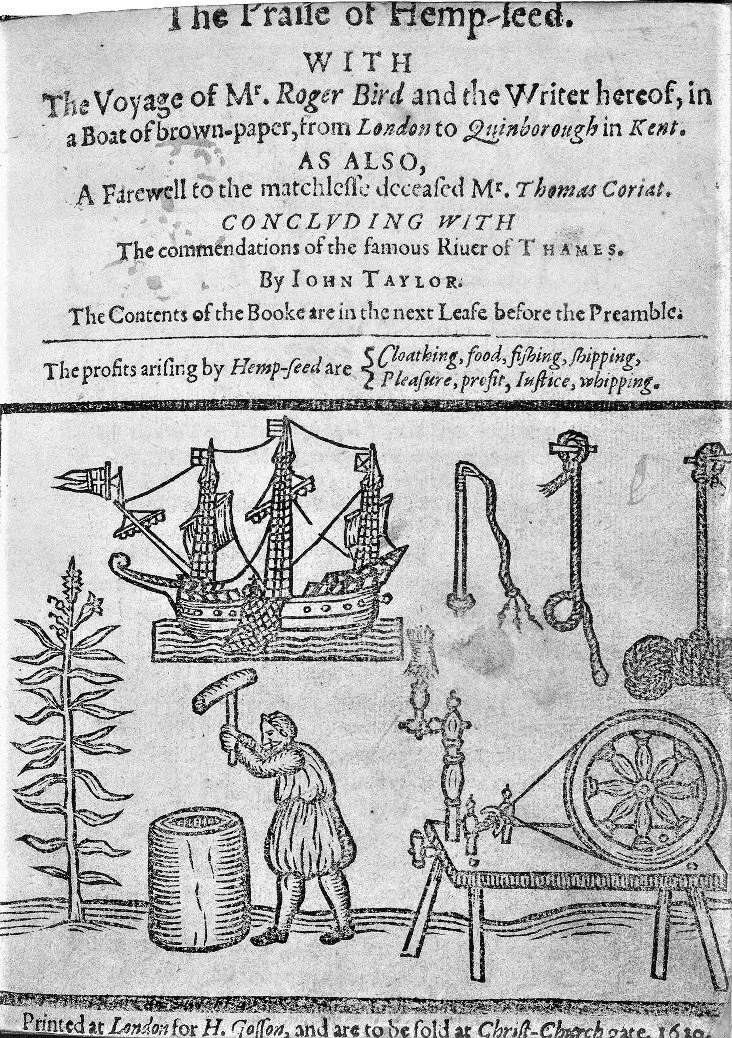
Apothecaries were not worth a pin,
If Hempseed did not bring their comings in;
Oils, Unguents, Syrups, Minerals, and Balms,
(All Natures treasures, and th’ Almighty’s alms,)
Emplasters, Simples, Compounds, sundry drugs
With Necromantic names like fearful Bugs,
Fumes, Vomits, purges, that both cures, and kills,
Extractions, conserves, preserves, potions, pills,
Elixers, simples, compounds, distillations,
Gums in abundance, brought from foreign nations.
Ovid ‘mongst all his Metamorphosis
Ne’re knew a transformation like to this,
Nor yet could Oedipus e’re understand,
How to turn Land to smoke, and smoke to Land.
For by the means of this bewitching smother,
One Element is turn’d into another,
As Land to fire, fire into Airy matter,
From air (too late repenting) turns to water…
By Hempseed thus, fire, water, air, earth, all
Are chang’d by pudding, leaf, roll, pipe and ball
—The Praise of Hemp-Seed (1620)
The Labyrinth of the World and the Paradise of the Heart
Chapter 12: The Pilgrim Examines Alchemy
Thereupon Mr. Ubiquitous remarked: “Now come along, for I shall take you to a place where you will find the highest peak of human ingenuity, and show you an occupation so delightful that anyone who has once turned to it is never again willing to abandon it as long as he lives, because of the charm and delight which it affords his mind.” I begged him not to delay in showing me. Thereupon he led me down into some cellars where I saw several rows of fireplaces, small ovens, kettles, and glass instruments, all shining brightly. Men tending the fires were gathering and piling on brushwood and blowing into it, or again extinguishing it, filling and pouring something from one glass into another. “Who are these folk, and what are they doing?” I asked. “They are the most ingenious of philosophers,” my interpreter answered, “effecting instantly what the celestial sun with its heat can effect in the bowels of the earth only after a considerable number of years: they transform various metals into their highest category, namely, gold.” “But for what purpose,” I asked, “since iron and other metals are of more frequent use than gold?” “What a dunce you are!” he exclaimed, “don’t you know that gold is the most precious of metals, and that he who has gold need fear no poverty?”
Lapis philosophicus
“Besides, that which has the potency to change metals into gold possesses other most astounding properties: for instance, it can preserve human health to the end of life, and ward off death for two or three hundred years. In fact, if men knew how to use it, they could make themselves immortal. For this stone is nothing less than the seed of life, the kernel and the quintessence of the universe, from which all animals, plants, metals, and the very elements derive their being.” I was affrighted, hearing such astounding news, and asked: “Are these people, then, immortal?” “Not all are so fortunate as to discover the stone,” he answered, “and those who find it do not always know how to use it effectively.” “If I had the stone,” I remarked, “I would take care to use it in such a way as to keep death away, and would procure plenty of gold for myself and others. But where is the stone to be found?” “It is prepared here,” he answered. “In these small kettles?” I exclaimed. “Yes.”
The mishaps of the alchemists
Full of curiosity, I walked about scrutinizing everything to learn what and how the thing was done; but I observed that not all fared equally. The fire of one was not hot enough: his mixture did not reach the boiling point. Another had too intense a fire, and his glass retorts cracked and something puffed out. As he explained it, the nitrogen had escaped; and he wept. Another, while pouring the liquid, spilled it or mixed it wrongly. Another burned his eyes out, and was thus unable to supervise the calcination and the fixation: or bleared his sight with smoke to such an extent that before he cleared his eyes the nitrogen escaped. Some died of asphyxiation from the smoke. But for the greatest part they did not have enough coal in their bags and were obliged to run about to borrow it elsewhere, while in the meantime their concoction cooled off and was utterly ruined. This was of very frequent, in fact of almost constant, occurrence. Although they did not tolerate anyone among themselves save such as possessed full bags, yet these seemed to have a way of drying up very rapidly, and soon grew empty: they were obliged either to suspend their operations or to run away to borrow.
After watching them, I said: “I see a good many here toil vain; but perceive none who succeeds in getting the stone. I also see that these people boil and burn both their gold and their lives, and often squander and burn both; but where are those with the heaps of gold and immortality?” “Naturally, they do not reveal themselves to you,” my interpreter answered, “nor would I advise them so to do. Such a priceless thing must be kept secret. For if one of the rulers learned of such a man, he would immediately demand his surrender and the poor fellow would become no better than a prisoner for life; consequently, they must keep themselves in hiding.”
Then I observed some of the scorched ones gather together, and turning my ear toward them, I heard them discuss the causes of their failures. One blamed the philosophers for their too involved description of the art; another lamented the brittleness of the glass implements; a third complained of an untimely and inauspicious aspect of the planets; a fourth was disgruntled with the earthly impurities of the mercury; a fifth complained of lack of capital. In short, there were so many causes of failure that I saw that they were at a loss to know how to mend their art. Thus when they left one after another, I left also.
A green Gum called our green Lyon, which Gum dry well, yet beware thou not burn his Flowers nor destroy his greenness.
—Sir George Ripley, The Bosome-Book of Sir George Ripley
Wherefore they being silent, Ripley the first, and indeed the only man of all, declares to us, that the key of all the more secret chemy lies in the milk and blood of the green lion... And therefore, to be more short, when all the parts of our stone, are thus gathered together, it appears plainly enough, what is our mercury, our sulphur, our alchemic body, our ferment, our dissolvent, our green lion.
—Five Preparations of the Philosopher's Mercury
By which Green Lion another saith, "All Philosophers understand Green Gold, multiplicable, spermatick, and not yet Perfected by Nature; or Assa Foetida, because in the very first of this Operation or Distillation, a white Fume with a stinking smell exhales"
I have ventured to call the Green Lion of Ripley the Key of the Work, because his Expositor has as good as called it so. "Learn then," says he, "to know this Green Lion, and its Preparation, which is all in all in the Art; it's the only Knot; untye it, and you are as good as Master: For whatever then remains, is but to know the outward Regimen of the Fire, for to help on Nature's Internal Work"
—A Short Enquiry Concerning the Hermetic Art
But they said I could not be a full colleague so long as I did not know their Lion and was fully aware of what he could do internally and externally.
—The Parabola of Madathanus
It will be questioned perhaps by the envious to what purpose these sheets are prostituted, and especially that drug wrapped in them - the Philosopher's Stone...
—Thomas Vaughan, Aula Lucis
Three things suffice for the work: a white smoke, which is water; a green Lion, which is the ore of Hermes, and a fetid water... The stone, known from the chapters of books, is white smoke and water.
—Michael Maier, Atalanta Fugiens
Of this self-same body, which is the matter of the Stone, three things are chiefly said; that it is a green Lion, a stinking Gum, and a white Fume... Having twelve pounds of Green Lion thus brought into gum, thou mayst believe...
—Philosophia Maturata
The Wolf is the antimony; the Lion, however, the pure gold... The philosophers have written entire books about it. Especially in the Rosarium it is often said that there are three things that do the work, Leo viridis (Green Lion), aqua foetida (evil-smelling water), and fumus albus (white steam).
—Johannes Agricola, Treatise on Gold
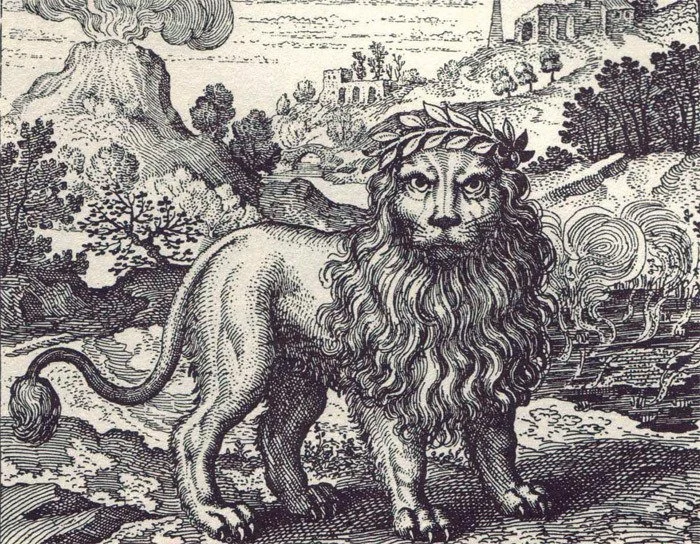
Atalanta Fugiens, 1617
The Book of Morienus
This stone is of delicate touch, and there is more mildness in its touch than in its substance. Of sweet taste, and its proper nature is aerial.
Khalid said: Tell me of its odor, before and after its confection.
Morienus answered: Before confectioning, its odor is very heavy and foul. I know of no other stone like it nor having its powers. While the four elements are contained in this stone, it being thus like the world in composition, yet no other stone like it in power or nature is to be found in the world, nor has any of the authorities ever performed the operation other than by means of it. And the compositions attempted by those using anything else in this composition will fail utterly and come to nothing. The thing in which the entire accomplishment of this operation consists of the red vapor, the yellow vapor, the white vapor, the green lion, ocher, the impurities of the dead and of the stones, blood, eudica, and foul earth.
Begin in the Creator’s name, and with his vapor take the whiteness from the white vapor. The whole key to accomplishment of this operation is in the fire, with which the minerals are prepared and the bad spirits held back, and with which the spirit and body are joined.
In answer to your question about the white vapor, or virgin’s milk, you may know that it is a tincture and spirit of those bodies already dissolved and dead, from which the spirits have been withdrawn. It is the white vapor that flows in the body and removes its darkness, or earthiness, and impurity, uniting the bodies into one and augmenting their waters.
Without the white vapor, there could have been no pure gold nor any profit in it.
Beware therefore of many, and hold thee to one thing. This one thing is naught else but the lyon greene...
—Bloomfield's Blossoms
First in our green Lion is had the true matter and of what colour it is, and is called Adrop or Azocke, Duenech.
—Donum Dei
Unvail'd, unbound, from Earthly Chains set free,
This third most sacred Fire the Sophi see,
Which Azot some, but others do it name
The Lyon Green, well known in Rolls of Fame.
—Verse on the Threefold Sophic Fire
These blear'd eyes
Have wak'd to read your several colours, sir,
Of the pale citron, the green lion, the crow,
The peacock's tail, the plumed swan…
Thou has descry'd the flower, the sanguis agni?
—Ben Jonson, The Alchemist
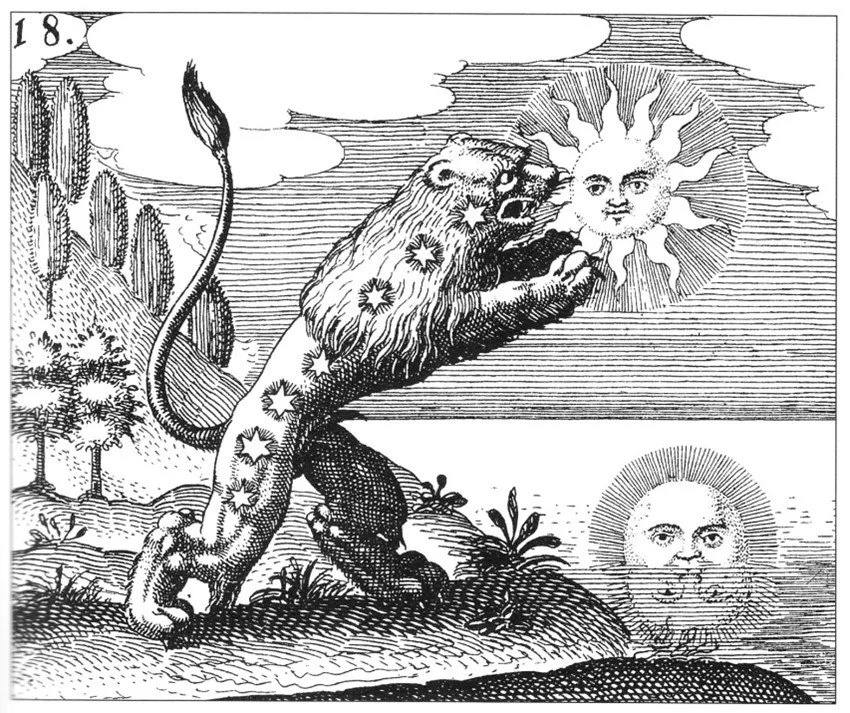
Atalanta Fugiens, 1617
Mercury is our doorkeeper, our balm, our honey, oil, urine, may-dew, mother, egg, secret furnace, oven, true fire, venomous Dragon, Theriac, ardent wine, Green Lion, Bird of Hermes, Goose of Hermogenes, two-edged sword in the hand of the Cherub the Tree of Life, etc.; it is our true, secret vessel, and the Garden of the Sages in which our Sun rises and sets.
—Eirenaeus Philalethes, Metamorphosis of Metals
Perfect bodies we naturally calcine with the first, without adding any impure body but one commonly called by philosophers the green lion, and this is the medium for perfectly combining the tinctures of the Sun and Moon.
—The Golden Tract
And now it is known in Metallic Mysteries, that at the very Entrance, we meet the enigma of the Lion of Green growth, which we call the Green Lion; which, I pray thee, do not think is so-called, from any other Cause but its Colour.
—Aesch Mezareph
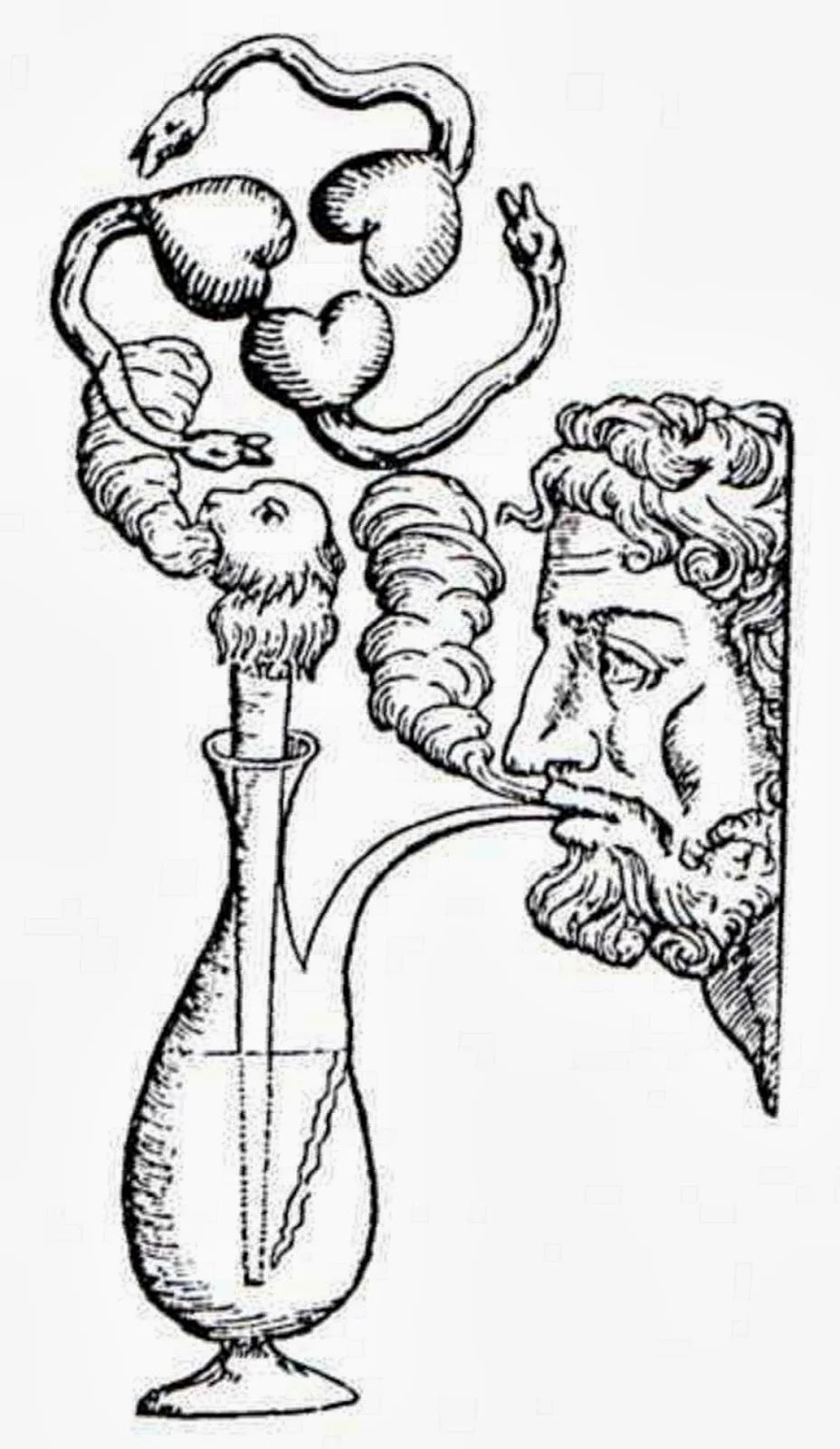
You have then nourished and dissolved the true lion with the blood of the green lion.
—The Golden Tripod
The aforesaid Green Lion's Blood is the true Philosopher’s Oil, above all aromas, always fixed and unalterable in the fire.
—Conrad Poyselius, Another Corollary
With the third which is a permanent incombustible unctuous humidity, our fire natural, Hermes tree is burnt to ashes... This menstrue [brought out of our earth by the water] is the blood of the green Lyon not of Vitriol, as dame Venus [that water] can tell you if you ask her in the beginning of the work. For this secret is hid by all Philosophers... After I knew the true matter I studied five years before I could extract out of the stone its precious juice by reason I knew not the secret fire of the sages which makes to flow out of this Plant which is dry in appearance, a water which wets not the hands which by the magical union of the dry water of the sea of the sages resolves it self into a viscous water, a mercurial liquor which is the principle the foundation & the Key of our art.
—Isaac Newton, Keynes MS #53
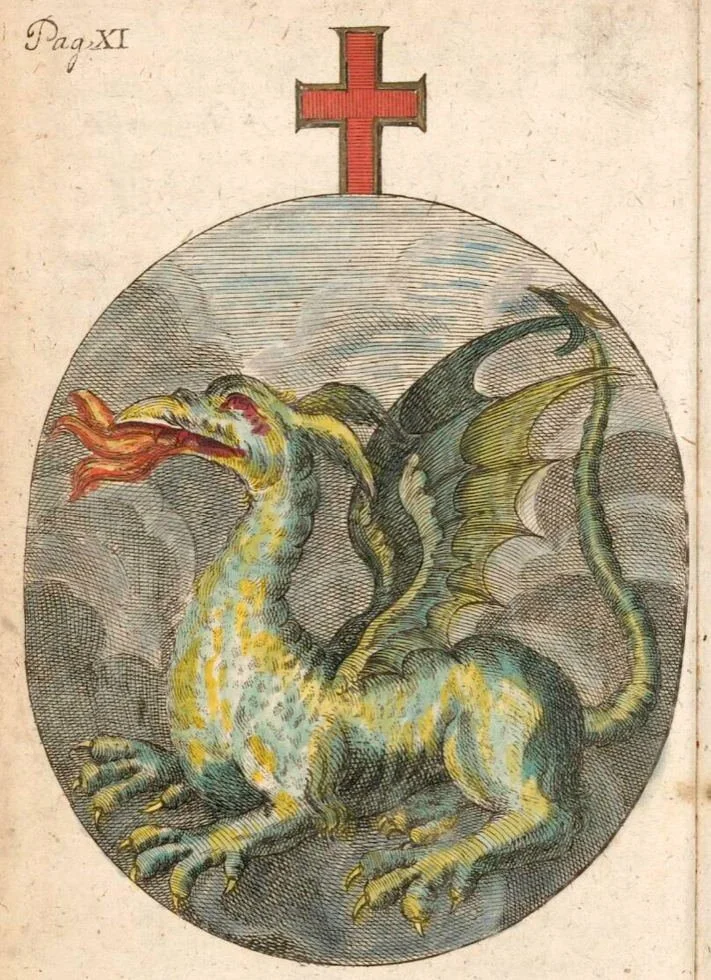
Many who found it were so intoxicated by its fumes that they remained in their place and could no longer raise themselves.
An Anonymous Treatise on the Philosopher's Stone
This is called the blessed stone; this earth is white and foliated, wherein the Philosophers do sow their gold... The fourth color is Ruddy and Sanguine, which is extracted from the white fire only.
—Jean d’Espagnet, The Hermetic Arcanum
O how many are the seekers after this gum, and how few there are who find it! Know ye that our gum is stronger than gold, and all those who know it do hold it more honorable than gold... Our gum, therefore, is for Philosophers more precious and more sublime than pearls...
—Turba Philosophorum
O pre-eminent gold of the philosophers, with which the Sons of the Wise are enriched, not with that which is coined.
—Thomas Vaughan, Anima Magica Abscondita
Therefore I affirm that the Universal Medicine for bodies is the philosophic gold, after it has been separated and drawn to the highest state of perfection. Our common gold has absolutely nothing in common with the philosophic gold we use to begin our task. In that respect common gold is dead and clearly useless.
—Philip a Gabella, Consideratio Brevis
Our fellow-workers must be able to recognize the true lead and mercury, which are neither common cinnabar nor mercury.
—Zhang Boduan, Wuzhen Pian
But what say you of this? The Philosophers say plainly, "Our Gold is not the common Gold, and our Silver not common Silver." I say that they call it water Gold because it ascendeth to higher things by virtue of the fire, and in truth that Gold is not common Gold, for the common people would not believe that it could ascend to higher matters by reason of its fixedness.
—Rosarium Philosophorum
I will now speak of the Philosophers' Secret, and blessed Viridity, which is to be seen and felt here below. It is the Proteus of the old Poets; for if the Spirit of this green Gold be at Liberty, which will not be till the Body is bound, then he will discover all the Essences of the Universal Center.
—Preface to the Rosicrucian Manifestos
Our Gold is not vulgar Gold, which is sold by goldsmiths, or anything like it, but it is a certain other substance more precious than Gold itself, whose green and golden Colour doth sufficiently demonstrate its original and Excellence...This is that Liquor permanent and Triumphing over all Metals and Stone, the blood of the Green Lion, the Secret Fire...
--Christopher Grummet, Sanguis Naturae
Our secret fire, that is, our fiery and sulfurous water, which is called Balneum Mariae... This water is a white vapor.
—The Secret Book of Artephius
Know the secret fire of the wise, which is the one and sole agent efficient for the opening, subliming, purifying, and disposing of the material.
—Letter to the True Disciples of Hermes
Study, then, this fire, for had I myself found it at the first, I should not have erred two hundred times upon the veritable material.
—John Pontanus, The Secret Fire
No philosopher has ever openly Revealed this secret fire, and this powerful Agent, which works all the Wonders of the Art.
—The Hermetic Triumph
It is the Philosophers' Fire, by which the Tree of Hermes is burnt to ashes.
—The Tomb of Semiramis
It is this most famous medicine which philosophers have been wont to call their Stone, or Powder. This is its fount and fundament, and the Medicine whereby Aesculapius raised the dead. This is the herb by which Medea restored Jason to life.
—Benedictus Figulus, A Golden and Blessed Casket of Nature's Marvels
Then must you wait till he shall obtain some substance from his mercury as it happens in the fruit of trees. For as the argent vive, both of perfect and imperfect bodies is a tree, so they can have no more nourishment, otherwise than from their own mercury… In this therefore, it is understood, that mercury, the much commended tree must be taken...
—The Summary of Philosophy
The Philosopher's stone, or tincture is nothing else, but Gold digested to the highest degree: For vulgar Gold is like an herb without seed, when it is ripe it brings forth seed; so Gold when it is ripe yields seed, or tincture.
—Michael Sendivogius
Take the fire, or quicklime, of which the philosophers speak, which grows on trees, for in that God himself burns with divine love.
—Gloria Mundi
It appears then that this Stone is a Vegetable, as it were, the sweet Spirit that proceeds from the Bud of the Vine...
—Count Bernard Trevisan, Verbum Dismissum
Trust my word, seek the grass that is trefiol. Thou knowest the name, and art wise and cunning if thou findest it.
—The Sophic Hydrolith
You ought to know concerning the Quintessence, that it is a matter little and small, lodged and harbored in some Tree, Herb, Stone, or the like...
—The Tomb of Semiramis
It contains the fire of Nature, or the Universal Spirit; with Air as its vehicle it contains Water, which must be separated in the beginning of the work, and also earth which remains behind in the form of caput mortuum, where the fire has left it, and is the true Red Earth wherein the fire dwelt for a while. The subject, duly collected, should not be less than eight nor more than sixteen ounces: place it in a china or glazed basin and cover it loosely to keep the dust out.
Sigismond Bacstrom, Rosicrucian Aphorisms and Process
Long have I had in my nostrils the scent of the herb moly which became so celebrated thanks to the poets of old... this herb is entirely chemical. It is said that Odysseus used it to protect himself against the poisons of Circe and the perilous singing of the Sirens. It is also related that Mercury himself found it and that it is an effective antidote to all poisons. It grows plentifully on Mount Cyllene in Arcadia...
—Michael Maier, Septimana Philosophica
The peace god of Cyllene had given him a white flower,
Moly the gods name it, and black is the root that holds it.
—Ovid, Metamorphoses
I call it the Flower of Honey,
The Flower known to the Wise...
Homer knew it well, and called it Moly...
The gods also have bestowed it upon man
As a singularly great gift,
Designed to assuage and comfort him.
It is called the Red and Green Lion…
—Certain Verses of an Unknown Writer, Concerning the Great Work of the Tincture
Depart from me, thou murky cave of Circe, for I am ashamed,
Belonging as I do to heaven, to eat acorns like a beast.
Rather do I pray to receive from God the soul-healing flower Moly,
The good physic against evil thoughts.
—Anthologia Palatina
The most renowned of herbs, on Homer’s testimony, discovered by Mercury as a remedy against all kinds of poisons….
—Pseudo-Apuleius
The most renowned of plants is, according to Homer, the one that he thinks is called by the gods moly, assigning to Mercury its discovery and teaching of its power over the most potent sorceries.
—Pliny
And Hermes gave Odysseus moly - the most effective of magic drugs - but his companions, in their stupidity, were transformed by Circe from men into irrational animals.
—Theocritus
I wasn't born on wandering Delos nor out of the waves of the sea nor 'in hollow caves', but on the very Islands of the Fortunate, where everything grows 'unsown, untilled'. Toil, old age and sickness are unknown there. There's no asphodel, mallow, onions, vetch or any other such worthless stuff to be seen in the fields, but everywhere there's moly, panacea, nepenthe, marjoram, ambrosia, and lotus, roses and violets and hyacinths, and gardens of Adonis to refresh the eye and nose. Born as I was amidst these delights I didn't start life crying, but smiled sweetly at my mother straight away.
Erasmus, In Praise of Folly
We can conclude from this that from the very beginning Homer's moly was a thing surrounded by mystery and that it is not the botanists but the mythologists who are really in a position to tell us the truth about it. Unfortunately, it is precisely what the mythologists have to tell us that has tended to be neglected, and even the most recent and learned discussions of the matter are content to relegate the question of this mythical symbolism to a couple of lines. In particular the story of the Christian symbolism connected with the "soul-healing flower" has received deplorably little attention and it is this that I shall make the starting-point of my enquiry.
Hugo Rahner, Greek Myths and Christian Mystery
In Thrace near the Hebrus there grows a plant which resembles the origanum (wild marjoram); the inhabitants of that country throw the leaves on a brazier and inhale the smoke, which intoxicates them.
Pseudo Plutarch, De Fluvius
The Scythians take the seed of this cannabis and, crawling under the mats, throw it on the hot stones, where it smoulders and sends forth such fumes that no Greek vapour-bath could surpass it. And they howl in their happiness at the vapour-bath.
Herodotus
The lower people [Sufis] are fond of raising their spirits to a state of intoxication... The smoke exalts their courage and throws them into a state in which delightful visions dance before their imagination.
Cartsen Niebuhr, Travels in Arabia
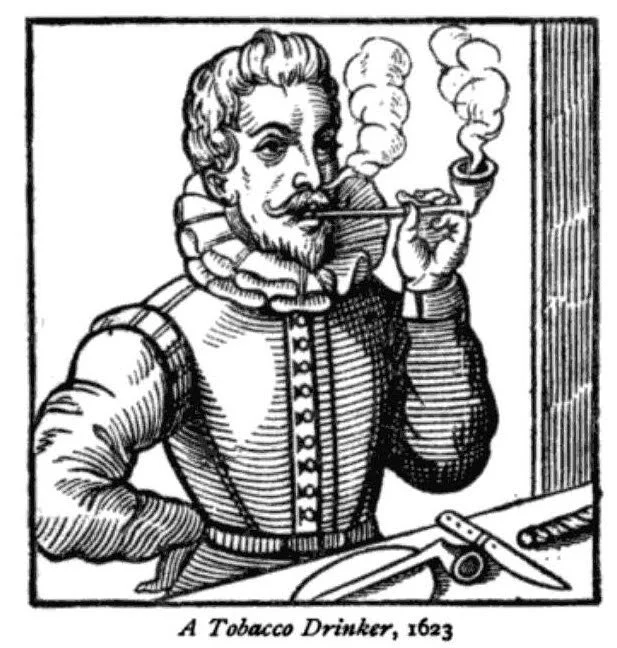
For take but Monardus his own tale; and by him it should seem; that in the taking of Tobacco they [the priests] were drawn up; and separated from all gross, and earthly cogitations, and as it were carried up to a more pure and clear region, of fine conceits & actions of the mind, in so much, as they were able thereby to see visions, as you say: & able likewise to make wise and sharp answers, and ecstasies, as we are wont to call it, have the power and gift thereby, to see more wonders, and high mystical matters, then all they can do, whose brains, & cogitations, are oppressed with the thick and foggy vapours of gross, and earthly substances... but being used to clear the brains, and thereby making the mind more able, to come to herself, and the better to exercise her heavenly gifts, and virtues; me think, as I have said, I see more cause why we should think it to be a rare gift imparted unto man, by the goodness of God, than to be an invention of the devil.
Roger Marbecke, Defense of Tobacco
There is an Hearbe in India, of pleasaunt smell, but who so commeth to it, feeleth pleasant smart, for there breede in it, a number of small Serpents.
John Lyly, Euphues and His England
...And another called bang, like in effect to opium, "which puts them for a time into a kind of ecstasis," and makes them gently to laugh.
Robert Burton, The Anatomy of Melancholy
It is hashish that brings enlightenment to reason; but he who devours it like food will become a donkey. The elixir is moderation; eat of it just one grain, so that it can permeate your existence like gold.
Amir Ahmad, Mahsati-Roman
To the Hindu the hemp plant is holy. A guardian lives in the bhang leaf... To see in a dream the leaves, plant, or water of bhang is lucky... No good thing can come to the man who treads underfoot the holy bhang leaf. A longing for bhang foretells happiness.
Besides as a cure for fever, bhang has many medicinal virtues... It cures dysentery and sunstroke, clears phlegm, quickens digestion, sharpens appetite, makes the tongue of the lisper plain, freshens the intellect, and gives alertness to the body and gaiety to the mind. Such are the useful and needful ends for which in his goodness the Almighty made bhang... It is inevitable that temperaments should be found to whom the quickening spirit of bhang is the spirit of freedom and knowledge. In the ecstasy of bhang the spark of the Eternal in man turns into light the murkiness of matter... Bhang is the Joygiver, the Skyflier, the Heavenly-guide, the Poor Man's Heaven, the Soother of Grief... No god or man is as good as the religious drinker of bhang... The supporting power of bhang has brought many a Hindu family safe through the miseries of famine. To forbid or even seriously to restrict the use of so holy and gracious an herb as the hemp would cause widespread suffering and annoyance and to large bands of worshiped ascetics, deep-seated anger. It would rob the people of a solace in discomfort, of a cure in sickness, of a guardian whose gracious protection saves them from the attacks of evil influences... So grand a result, so tiny a sin!
J.M. Campbell, "On the Religion of Hemp" Indian Hemp Drugs Commission Report
The five kingdoms of plants, having soma as their chief (crestha), we address; the darbha, hemp, barley, saha - let them free us from distress.
Athara-Veda
It creates vital energy, increases mental powers and internal heat; corrects irregularities of the phlegmatic humour; and is an elixir vitae. It was originally produced, like nectar, from the ocean by churning with Mt. Mandara, and inasmuch as it gives victory in the three worlds, it, the delight of the king of the gods, is calledvijaya, the victorious. This desire-fulfulling drug was obtained by men on earth, through desire for the welfare of all people. To those who regularly use it, it begets joy and destroys every anxiety.
Rajavallabha
The subtler attainments come with birth or are attained through herbs, mantra, austerities, or concentration.
Yoga Sutras of Patanjali
The fourth method of awakening [i.e. enlightenment] is through the use of specific herbs. In Sanskrit it is called aushadhi… knowledge of the herbs is a closely guarded secret…
Swami Saraswati, Kundalini Tantra
By means of drugs and incantations one may change bronze into gold. By skilful use of chemical substances, silver may be transformed into gold and gold into silver.
Prafulla Chandra Ray
[The Hindus] have a science similar to alchemy which is quite peculiar to them. The call it rasayana. It means an art which is restricted to certain operations, drugs, and compound medicines, most of which are taken from plants.
Al-Biruni
The philosophers have called this maid and blessed water by many thousands of different names in their books. They call it heaven, a heavenly water, a heavenly rain, a heavenly thaw, a May thaw, water of Paradise, an aqua fortis and an aquam Regis, a corrosive aquafort, a sharp vinegar and liquor, also Quintam essentiam vini, a waxy green juice, waxy mercurium, green water and Leonem viridis, quicksilver, menstruum or blood. They also call it urine and horse piss, milk and virgin’s milk, water of arsenic, silver, Luna or Lunae water, woman, a female seed, a sulphuric steam and smoke, a fiery, burning spirit, a deathly all-penetrating poison, a dragon, a scorpion which eats its young, a hellish fire of horse dung, a sharp salt, sal armoniacum, a common salt, a lye, a viscous oil, the stomach of an ostrich which eats and digests all things, an eagle, a vulture and hermetic bird, a vessel and Sigillum Hermetis, a melting and calcinating oven, and innumerable other names of animals, birds, plants, waters, juices, milks and blood, etc. They have used all these names and written of it figuratively in their books. They have suggested that such a water is made of these things, with the result that all ignorant people who have searched for it in these things, have not found the desired water.
A Magnificent and Select Tract on the Philosophical Water
Yoga
The path to the Truth is a labour of the heart, not of the head. Make your heart your primary guide! Not your mind. Meet, challenge and ultimately prevail over your nafs with your heart. Knowing your ego will lead you to the knowledge of God.
—Shams Tabrizi
His constant fight is with the Nafs (self-interest), the root of all disharmony and the only enemy of man. By crushing this enemy, man gains mastery over himself; this wins for him mastery over the whole universe, because the wall standing between the self and the Almighty has been broken down. Gentleness, mildness, respect, humility, modesty, self-denial, conscientiousness, tolerance and forgiveness are considered by the Sufi as the attributes which produce harmony within one's own soul as well as within that of another.
—Hazrat Inayat Khan
Your worst enemy is hiding within yourself, and that enemy is your nafs or false ego.
— Rumi
Vivekananda‘s quotes on realisation
He who has realised the Atman becomes a storehouse of great power.[Source]
Hold we on to realisation, to being Brahman, to becoming Brahman.[Source]
If there is a God we must see Him, if there is a soul we must perceive it; otherwise it is better not to believe.[Source]
If we once understand that this realisation is the only religion, we shall look into our own hearts and find how far we are towards realising the truths of religion.[Source]
It is this power of realisation that makes religion. No amount of doctrines or philosophies or ethical books, that you may have stuffed into your brain, will matter much, only what you are and what you have realised. So we have to realise religion.[Source]
It was the same God, and the different realisations were only degrees and differences of vision.[Source]
Not talking, theorising, argumentation, but realisation. That I call practical religion.[Source]
Our own realisation is beyond the Vedas, because even they depend upon that.
Religion is, after all, realisation, and we must make the sharpest distinction between talk; and intuitive experience. What we experience in the depths of our souls is realisation.[Source]
Realisation is beyond virtue and vice, beyond future and past; beyond all the pairs of opposites.[Source]
Realisation is real religion, all the rest is only preparation — hearing lectures, or reading books, or reasoning is merely preparing the ground; it is not religion. Intellectual assent and intellectual dissent are not religion.[Source]
Realisation of love comes to none unless one becomes a perfect Jnani.[Source]
Realisation will come in the fullness of time, by living constantly in the company of Sâdhus (holy men).[Source]
Religious realisation does all the good to the world.[Source]
Talking is one thing, and realising is another.[Source]
The essential truth is realisation.[Source]
The man who realises, “I am He”, though clad in rags, is happy.[Source]
The only power is in realisation, and that lies in ourselves and comes from thinking.[Source]
This realisation alone is the soul of religion.[Source]
Until your religion makes you realise God, it is useless.[Source]
What we experience in the depths of our souls is realisation.[Source]
When a man realises, he gives up everything.[Source]
Alchemy
Herbal medicines and drugs play a more important part in Chinese alchemy than in the western branches. Plant-produced drugs were supposed to give quick but more transient results, while those from minerals were slower but surer... although authorities like Ko Hung assert that metals produce better results in this world, it must be remembered that the immortals of the Isle of P'eng used herbs, since the herbs of immortality grew there and it was to obtain these that the various expeditions were mounted.
—Jean Cooper, Chinese Alchemy: The Taoist Quest for Immortality
Leo Viridis- is the Ore of Hermes... The green is that which is perfect upon the stone, and can easily be made into gold. All growing things are green, as also our stone. It is called a plant. The stone cannot be prepared without green... Gold, according to some opinions.
—Martinus Rulandus, Lexicon of Alchemy
This substance the philosophers called immature or unripe gold, or the "Green" Lion... Having said this, because he had proved it, he called the first substance "green lion" and "unripe gold," for so it is.
—R.W. Councell, Apollogia Alchymiae
You will see marvelous signs of this Green Lion, such as could be bought by no treasures of the Roman Leo. Happy he who has found it and learned to use it as a treasure!
—Paracelsus, The Treasure of Treasures
By which Green Lion another saith, "All Philosophers understand Green Gold, multiplicable, spermatick, and not yet Perfected by Nature; or Assa Foetida, because in the very first of this Operation or Distillation, a white Fume with a stinking smell exhales"
I have ventured to call the Green Lion of Ripley the Key of the Work, because his Expositor has as good as called it so. "Learn then," says he, "to know this Green Lion, and its Preparation, which is all in all in the Art; it's the only Knot; untye it, and you are as good as Master: For whatever then remains, is but to know the outward Regimen of the Fire, for to help on Nature's Internal Work"
—A Short Enquiry Concerning the Hermetic Art
But they said I could not be a full colleague so long as I did not know their Lion and was fully aware of what he could do internally and externally.
—The Parabola of Madathanus
Then the sowing of the field can take place, and you obtain the Mineral Stone, and the Green Lion that imbibes so much of its own spirit.
—The Glory of the World