Shakespeare and the Virgin Queen
(this page will take a while to finalize)
I nodded. His meaning had not escaped me. If you analyzed it, it was the old Bacon and Shakespeare gag. Bacon, as you no doubt remember, wrote Shakespeare’s stuff for him and then, possibly because he owed the latter money or it may be from sheer good nature, allowed him to take the credit for it. I mentioned this to Jeeves, and he said that perhaps an even closer parallel was that of Cyrano de Bergerac.
P.G. Wodehouse, Joy in the Morning
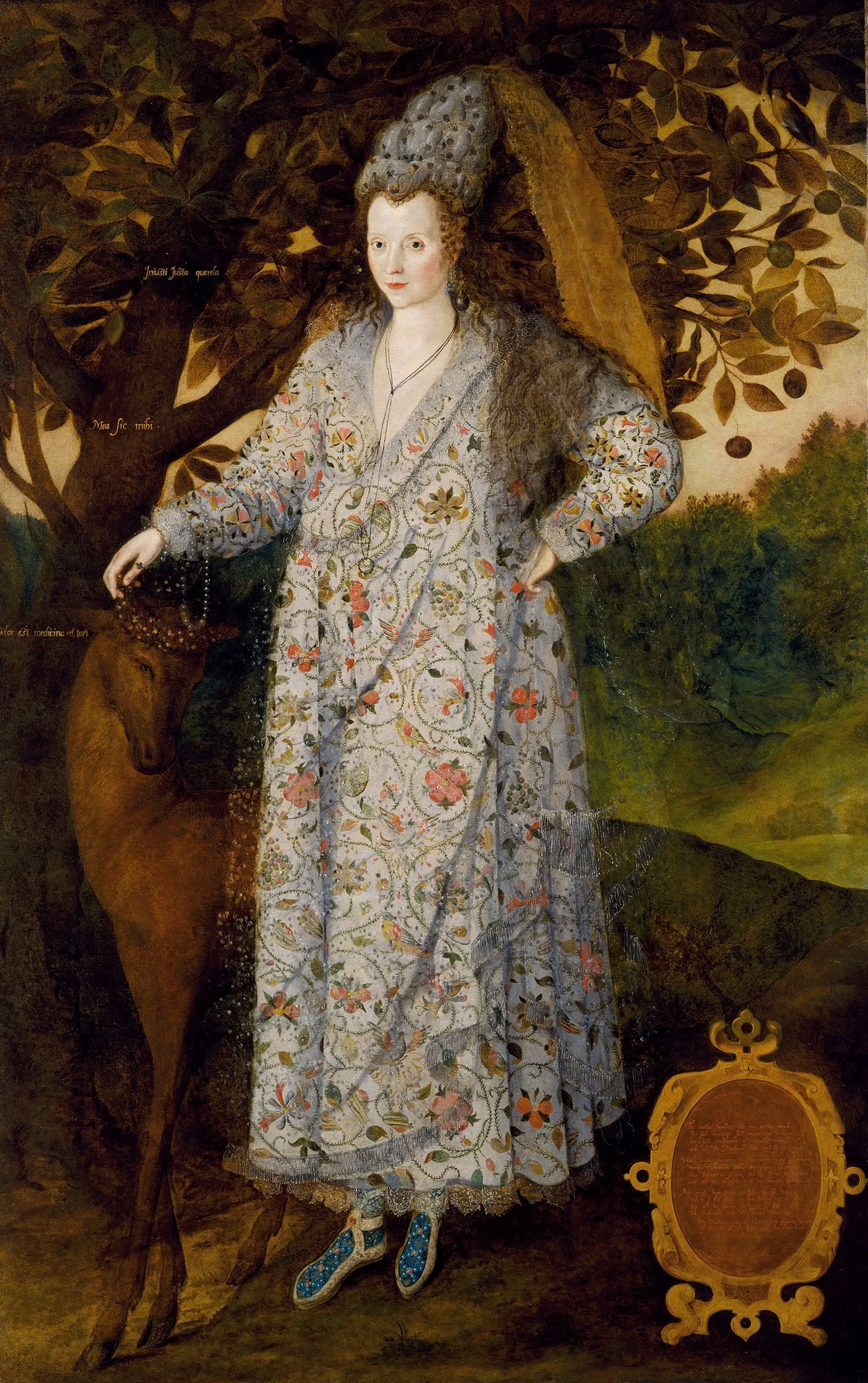
Pregnancy portrait of Elizabeth I, Hampton Court Palace
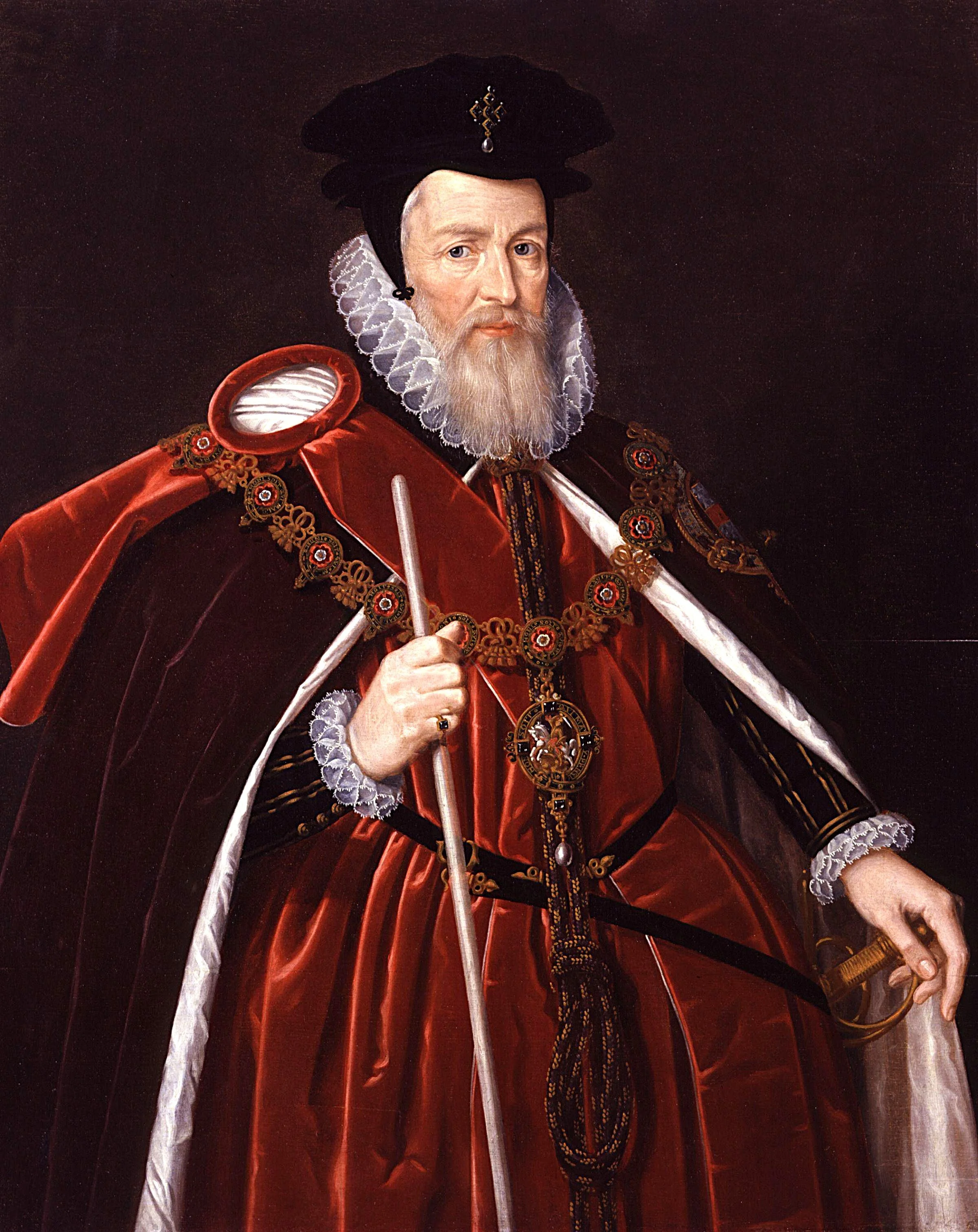
William Cecil, Francis Bacon’s uncle and Elizabeth’s chief advisor
There be some whose lives are as if they perpetually played a part upon a stage, disguised to all others, open only to themselves.
—Francis Bacon, “Of Friendship”
History remembers Elizabeth I as the Virgin Queen, serenely detached from erotic entanglement and ruling through symbolic chastity. Diplomatic correspondence from the first years of her reign tells a markedly different story. Between 1559 and 1561, ambassadors from Spain, Venice, France, and England itself repeatedly reported an intimacy between Elizabeth and Robert Dudley so conspicuous that it generated rumors of marriage, pregnancy, and even homicide across Europe. These reports were not pamphlets or polemics, but private intelligence sent by senior diplomats to their sovereigns and councils, preserved today in the great editorial series known as the Calendar of State Papers, collections that summarize and translate original dispatches housed in archives at Simancas, Venice, Paris, and London.
Early testimony comes from Count de Feria, Philip II’s ambassador during the final months of Mary I and the opening of Elizabeth’s reign. Writing privately to Spain in April 1559, de Feria reported that Elizabeth’s attachment to Dudley was already notorious at court. In a dispatch dated 18 April 1559, he stated bluntly that “it is even said that her Majesty visits him in his chamber day and night.” De Feria was Catholic and hostile to Elizabeth, but he was a seasoned grandee, writing confidentially to his king, with no reason to invent behavior that could easily be contradicted by other diplomats in London.
This assessment was independently confirmed by Venice. Giovanni Michiel Schifanoya, reporting to the Venetian Senate on 10 May 1559, described Dudley as enjoying extraordinary favor and familiarity with the Queen. In the Calendar of State Papers Venetian, his words are rendered to the effect that “My Lord Robert is in very great favour and very intimate with Her Majesty.” Venice had no stake in English succession politics and no reason to echo Spanish hostility; Schifanoya’s report demonstrates that Elizabeth’s conduct was being noticed by neutral observers almost immediately after her accession.
From Paris, similar intelligence circulated through diplomatic networks. Giacomo Surian, writing in 1559, informed Venice that the Queen’s affection for Dudley appeared so decisive that foreign courts believed it would determine her marital future entirely. His dispatch is commonly translated as stating that “the love which Her Majesty bears to Milord Robert is so great that she will end by marrying him, or else marry no one.” Surian was not resident in London, but the significance of his report lies in how quickly the Dudley–Elizabeth relationship was being interpreted abroad as exclusive and potentially permanent.
A rumor that Elizabeth was pregnant bruited among the public; in August of 1560, one Anne Dowe of Brentwood, a sixty-eight-year-old widow, was jailed for speaking thus indiscreetly. Álvaro de la Quadra, Bishop of Aquila and successor to de Feria as Spain’s representative, reported that a trusted informant had told him Dudley had sent to poison his wife, adding that Elizabeth’s handling of marriage negotiations seemed designed to distract opposition until, as he put it, “this wicked deed” was accomplished. In early September, de Quadra met with William Cecil, Elizabeth’s chief counselor, and wrote of the encounter—
“It is not my meaning to treat him as a ward: Such a word is far from my Motherly feeling for him. I mean to do him good.”
—Lady Anne Bacon in a letter to Anthony Bacon, 18 April 1593
Francis Bacon was raised in a household that stood at the nerve center of Elizabethan governance, learning, and reform. His father, Sir Nicholas Bacon, served as Lord Keeper of the Great Seal and was widely respected for his legal prudence, moderation, and commitment to institutional stability. Though not a grand stylist or visionary theorist, Sir Nicholas embodied the virtues of the Tudor civil servant: administrative competence, fidelity to the crown, and a belief that law was the principal instrument through which order could be maintained in a fragile post-Reformation polity. His career placed Francis, from infancy, within sight of the highest legal and political mechanisms of the realm.
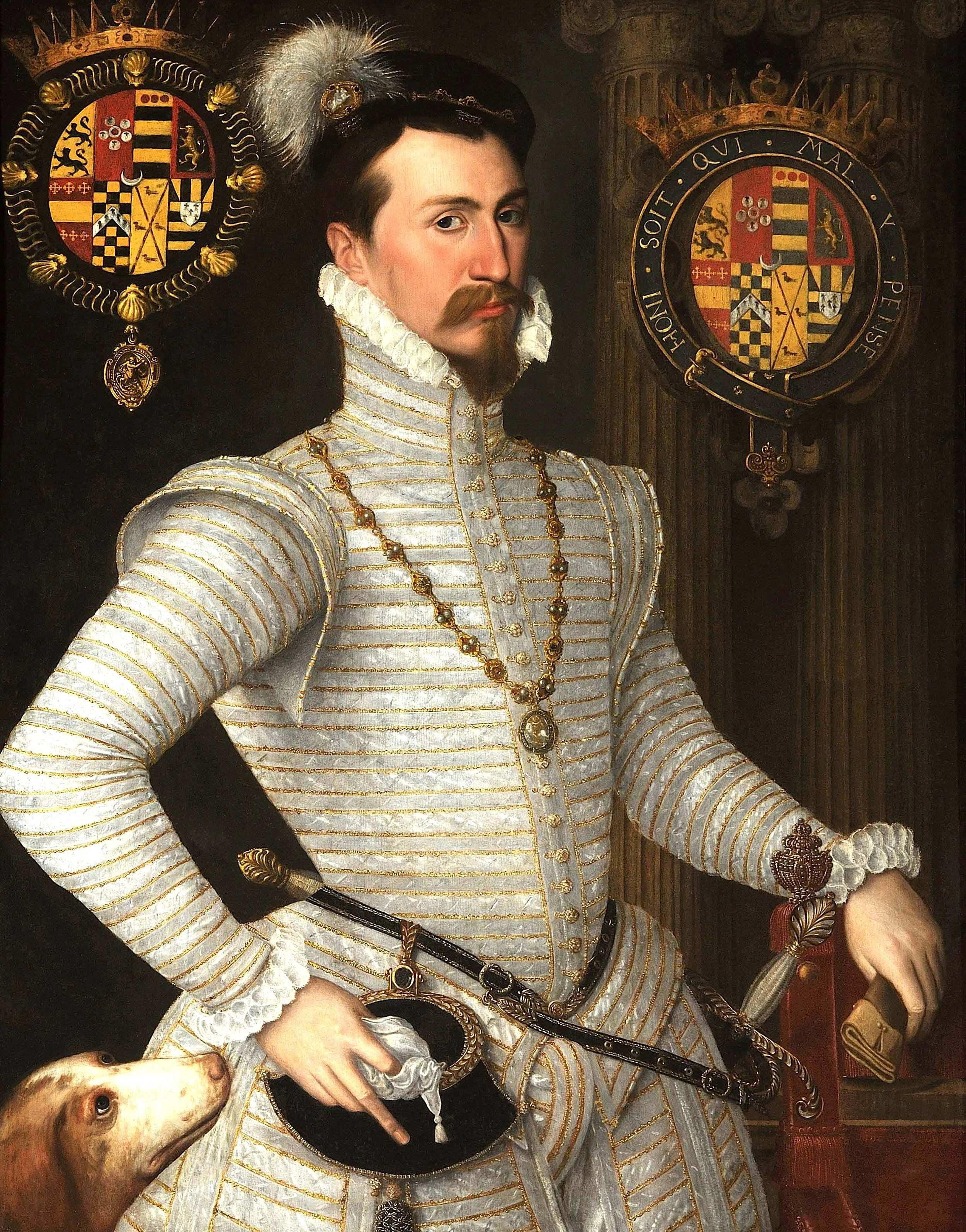
Robert Dudley
[Cecil] said that the Queen was going on so strangely that he was about to withdraw from her service . . . Lord Robert had made himself master of the business of the state and of the person of the Queen, to the extreme injury of the realm, with the intention of marrying her, and she herself was shutting herself up in the palace to the peril of her health and life. That the realm would tolerate the marriage, he said he did not believe . . . Last of all, he said that they were thinking of destroying Lord Robert’s wife. They had given out that she was ill, but she was not ill at all; she was very well and taking care not to be poisoned . . . Since writing the above, I hear the Queen has published the death of Robert’s wife.[1]
[1] Letter to the Duchess of Parma, dated 11 September 1560
By the end of 1560, rumors of secret marriage and pregnancy were circulating so widely that even England’s own representatives were forced to address them. Nicholas Throckmorton, Elizabeth’s ambassador at the French court, wrote to William Cecil on 31 December 1560 that “the bruits of her doings be very strange in all courts and countries.” He reported that the Spanish ambassador in France had asked him directly whether the Queen was not already secretly married to Lord Robert—an inquiry Throckmorton neither confirmed nor dismissed, but which demonstrates how far such suspicions had spread.
De Quadra’s letters of January 1561 show that the crisis had not abated. Writing to Philip II on 22 January, he warned that if Elizabeth married Dudley without Spanish sanction, Philip had only to “give a hint” to her subjects and she would lose her throne. He described the Queen as “infatuated to a degree which would be a notable fault in any woman, much more in one of her exalted rank,” and reported that Dudley himself claimed a willingness to restore Catholicism if Philip would countenance the match. In the same letter, de Quadra added cautiously, “Some say she is a mother already, but this I do not believe,” a line that neatly captures both the intensity of the rumor and the diplomat’s own restraint.
Taken together, these dispatches form a coherent chronological record. From early 1559 through early 1561, multiple ambassadors independently observed or reported an intimacy between Elizabeth and Dudley that they believed had political consequences. The importance of this correspondence does not lie in proving marriage, pregnancy, or murder as historical facts, but in demonstrating how Elizabeth’s private conduct was perceived by contemporaries, and how urgently foreign powers believed it threatened the stability of the English succession.
The reason Elizabeth did not marry Robert Dudley was not lack of affection, but the political reality that such a marriage threatened the stability of her reign. Diplomatic correspondence makes clear that Dudley was widely detested, and for reasons that contemporaries understood perfectly well. He was the son of the Duke of Northumberland, the architect of the 1553 coup that placed Lady Jane Grey on the throne, and the Dudley name remained indelibly associated with treason, executions, and the near-collapse of the Tudor succession. The mysterious death of Dudley’s wife in 1560 made him politically radioactive; even unproven suspicion was sufficient to alienate nobles already predisposed to distrust him.
Beyond personal scandal lay deeper structural fears. A Dudley marriage would have meant the sudden dominance of a single court faction, the exclusion of rival noble houses, and a return to the hated politics of the royal favorite. Most dangerous of all was the succession question. A Dudley heir would inevitably be contested, potentially illegitimate in the eyes of large sections of the political nation, and capable of triggering the very civil war Elizabeth’s accession had narrowly avoided. When de Quadra warned Philip II in January 1561 that a Dudley marriage could cost Elizabeth her throne with only “a hint” to her subjects, he was not indulging in hyperbole. He was articulating a consensus shared across courts and councils alike.
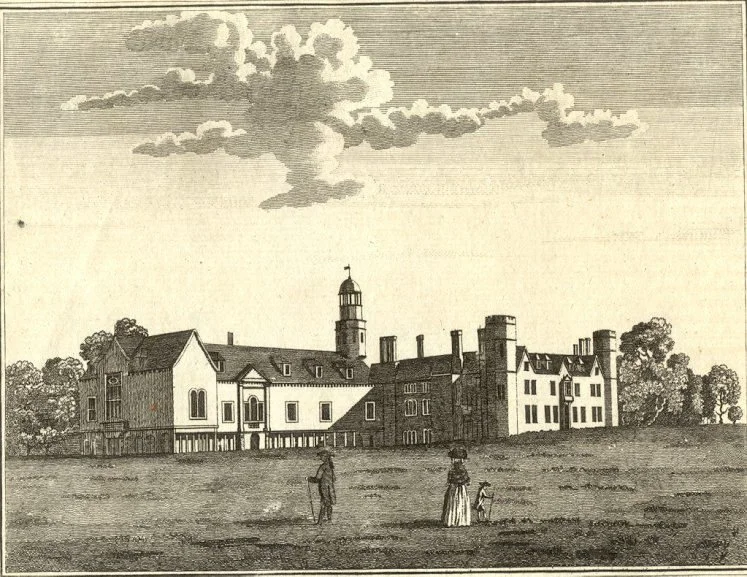
Gorhambury House, Bacon’s childhood home near St. Albans, Herefortshire
Lady Anne Bacon, by contrast, brought into the household a formidable humanist and theological intensity. Anne Bacon, née Cooke, was among the most learned women in England; her father, Sir Anthony Cooke, had tutored Edward VI. Fluent in Latin, Greek, Italian, and French, she translated major Protestant theological works and maintained correspondence with leading reformers on the Continent. Her piety was rigorous, introspective, and morally exacting, shaped by the evangelical wing of the English Reformation. If Sir Nicholas represented the stabilizing force of law and office, Lady Anne represented the claims of conscience, scripture, and inward discipline. Francis thus grew up in a household where legal reason and moral seriousness were not opposed, but held in constant dialogue.
This domestic world was further intensified by its proximity to the household of William Cecil, Elizabeth I’s principal minister and the architect of much of her long and successful reign. Cecil was married to Lady Anne Bacon’s sister Mildred, herself a renowned scholar and patron of learning. Mildred Cecil shared her sister’s humanist education and religious seriousness, and the Cecil household became an extension of the Bacon domestic sphere, a kind of informal academy where politics, theology, classical learning, and statecraft intersected daily.
In this sense, Bacon’s early formation was not merely privileged but structurally charged. He was raised at the crossroads of law, religion, and governance, within families that effectively were the Elizabethan regime. The ideals and limitations of that world, its reverence for order and its fear of disorder, its moral earnestness and its resistance to radical change, formed the matrix against which Bacon would later define his own project. His call for a “Great Instauration” did not arise in opposition to the Tudor state, but from within its most intimate households, shaped by the very people who had built and sustained it.
What formed Bacon was not simply “a good education,” nor even extraordinary intelligence, but a configuration of pressures, intellectual, moral, political, and psychological, that is no longer available, and in many respects should not be. Bacon was shaped in a world that placed enormous demands on children of the governing elite. Expectation was relentless; moral scrutiny was intense; failure carried real consequences not only for oneself but for one’s family and nation. He absorbed law, theology, rhetoric, and politics, not as optional attainments but as matters of survival and duty. The early modern household, especially one so close to power, did not distinguish sharply between childhood and preparation for adult responsibility. Formation began early because it had to.
“Lord Bacon was the greatest genius that England, or perhaps any country, ever produced.”
—Alexander Pope
We are still far from knowing even half enough about Lord Bacon—the first realist in the grand sense—to know everything he did, everything he willed, and everything that went on in the depths of his soul… Let the critics go to hell!
Freidrich Nietzsche, Ecce Homo
My Shakespeare skepticism began with reading Richard III and then Richard II in close succession. Richard III is rhetorically assured; Richard II, by contrast, is hesitant in places, even clumsy. That difference makes sense once the political stakes of Richard III are acknowledged. The Tudor dynasty derived its legitimacy from Richard’s overthrow; to secure that legitimacy, Richard could not merely be defeated, he had to be damned. The play does precisely this work. Richard is rendered monstrous from birth, stripped of ambiguity and positioned as an affront to divine order itself. His fall is not simply historical but providential. The Tudors inherit not a contested throne, but a moral restoration. In this sense Richard III is not merely drama, but a major act of statecraft: a theatrical extension of Tudor historiography, legitimating regime change by transfiguring politics into theology.
I didn’t know all that, of course, but years earlier a high-school teacher had remarked that Romeo and Juliet was written by the Earl of Oxford. At the time it meant nothing. Only later did it reappear, not as a claim demanding belief, but as an invitation to investigate. Once the assumption of a single, seamless authorial voice loosens, attention shifts from personalities to pressures: who wrote these plays, under what conditions, and at what risk.
From there the path to Bacon was rapid. Bacon matters because he understood, more clearly than anyone of his age, the intimate relationship between knowledge, power, legitimacy, and controlled disclosure. The Shakespearean histories and Bacon’s philosophical project inhabit the same symbolic terrain: both are concerned with lawgiving, succession, rebellion, sovereignty, and the dangerous necessity of indirection in a political culture where speech itself could be fatal.
In this light, Shakespeare begins to resemble something like England’s moon landing: an achievement so vast, so central to national identity, that it requires an official story to hold it in place. Everyone knows the story; few examine its engineering. This book does not ask the reader to abandon the canon, only to read it with historical nerves intact; to notice where drama serves power, where it strains against it, and where the fractures of state necessity leave their marks in art.
“You must have heard of Shakespeare. He’s well known. Fellow who used to write plays. Only Aurelia’s aunt says he didn’t. She maintains that a bloke called Bacon wrote them for him.” “Dashed decent of him,” said Archibald, approvingly. “Of course, he may have owed Shakespeare money.” “There’s that, of course.”
P.G. Wodehouse, “The Reverent Wooing of Archibald”
(Wodehouse is alluding to the fact that the real Shaxpere of Stratford was a moneylender who sued people over relatively trifling sums.)
Contemporaries of Bacon eulogized him as “a muse more choice than the nine muses” who “showered the age with frequent volumes” and “filled the world with works”; “the very nerve of genius, the marrow of persuasion, the golden stream of eloquence, the precious gem of hidden literature.”[1] Ben Jonson’s Timber, published posthumously in 1641, states that Bacon “performed that in our tongue which may be compared, or preferred, either to insolent Greece or haughty Rome . . . he may be named and stand as the mark and acme of our language.” This is somewhat puzzling, as Bacon published just three books in English during his life, the Essays (in successively expanded editions, 1597, 1612, 1625), The Advancement of Learning (1605), and The History of the Reign of King Henry VII (1622). Even more strangely, Jonson (who was sparing in his praise of other writers) had already bestowed the same encomium upon Shakespeare in the 1623 First Folio:
Leave thee alone for the comparison
Of all that insolent Greece or haughty Rome
Sent forth, or since did from their ashes come.
An early claim that Bacon wrote anonymously occurred in 1599.[2] After English authorities published an account of a plot to poison Queen Elizabeth’s saddle, an anonymous writer ascribed the state’s “smooth penned pamphlet” to “M. Smokey-swynes flesh, at the instance of Sir R.C.” (i.e., Francis Bacon writing at the behest of Secretary of State Robert Cecil). This is again rather strange, as Bacon had only published a small book of ten essays and some religious meditations in his own name, very little to inform attribution of other tracts. Thomas Tenison, who crowned two monarchs as Archbishop of Canterbury, edited a volume of Bacon’s previously unpublished materials in 1679, in which he wrote “those who have true skill in the works of the Lord Verulam, like great masters in painting, can tell by the design, the strength, the way of colouring, whether he was the author of this or the other piece, though his name be not to it.”[3] A period of twenty years separates the time when Bacon left Cambridge in 1576 to when his name first appeared in print, with the publication of his Essays in 1597; yet, according to Brian Vickers, editor of the Oxford Major Works, Bacon had a substantial body of anonymous work and was reluctant to have his name in print:
Although Bacon had a wide and diverse literary output by 1597 (enough to fill several hundred pages of Spedding’s edition of his Occasional Works), none of it had been publicly acknowledged as his composition. Indeed, it was only due to an impending plagiarization that his name finally appeared in print that year, to forestall the unauthorized publication of his Essays . . . Had Serger not attempted his unauthorized edition, Bacon’s first appearance in print might have been as the author of The Advancement of Learning (1605), that bold attempt to persuade King James to initiate a total reformation of study and research in his new kingdom.[4]
Bacon’s writings may have been collaborative to a considerable extent. The article “Who Wrote Bacon? Assessing the Respective Roles of Francis Bacon and His Secretaries in the Production of His English Works” applies modern stylometric (wordprint) analysis to a long-standing puzzle in Bacon scholarship: how Bacon could have produced such a vast, stylistically inconsistent body of work while maintaining an exceptionally demanding political career. Using two independent statistical methods, the authors compare Bacon’s handwritten letters (autographs) with his published English works and with texts by contemporaries, including Thomas Hobbes. The central finding is stark: Bacon’s autographic writings display a consistent, identifiable wordprint, but most of the works published under his name do not match it.
The authors argue that the most economical explanation for this discrepancy is Bacon’s extensive reliance on secretaries and collaborators. While Bacon clearly possessed a stable personal writing style, detectable in his handwritten letters, that style is largely absent from his published corpus. Statistical comparisons show that over half of Bacon’s published English works differ so strongly from his autograph wordprint that they are unlikely to have been written solely by him. Only one major published work—the Apology Concerning the Earl of Essex—consistently matches Bacon’s autograph style, suggesting it was composed directly by Bacon during a moment of personal and political crisis.
The study further explores the possibility that Thomas Hobbes, who served intermittently as Bacon’s secretary, may have contributed substantially to certain texts, particularly portions of New Atlantis and some historical writings. While the authors stress that stylometric evidence cannot conclusively prove authorship in cases of collaboration, several Bacon texts cluster closely with Hobbes’s known wordprint. This overlap is strongest during periods when Hobbes is historically documented as having access to Bacon, lending circumstantial support to the hypothesis of significant Hobbesian involvement, especially in early and middle sections of New Atlantis.
Importantly, the authors reject sensational conclusions. They do not argue that Bacon lacked originality or that his philosophical ideas were authored by others. Instead, they propose a model of distributed authorship, common in early modern political and intellectual life, in which Bacon functioned as an originator, director, and editor of ideas that were often drafted, phrased, or expanded by secretaries. Historical evidence, ranging from household records to John Aubrey’s accounts of Bacon dictating ideas during walks, strongly supports this picture of collaborative production.
The article concludes that recognizing Bacon’s reliance on secretarial assistance resolves several long-standing anomalies: contradictions in style, shifts in tone, and the sheer volume of output. Rather than undermining Bacon’s significance, this perspective reframes him as an intellectual architect whose ideas were realized through a collective process. The authors suggest that future scholarship should focus less on defending single authorship and more on reconstructing the institutional and collaborative conditions under which Bacon’s thought was produced.
Alan Stewart, co-chair of the Oxford Francis Bacon and co-author of the biography Hostage to Fortune, describes a scenario whereby
Surviving autograph drafts by Bacon—that is, tracts written in his own handwriting—are scant indeed, and most of them are notes, occurring in commonplace books and notebooks . . . the norm is a draft in the hand of one of Bacon’s secretaries or amanuenses, with Bacon’s autograph comments, often quite extensive emendations . . . That these writings range in date from 1603 to 1621 suggests that Bacon’s preferred form of writing may always have been collaborative.[5]
The Workes of Benjamin Jonson (1616) is seen as a forerunner of the Shakespeare First Folio, being the first time an English playwright’s works were issued in a large, expensive folio edition. Evidently it was a collaborative effort; Jonson’s statement that he wrote Volpone “without a co-adjutor, novice, journey-man or tutor” implies that
The main author reigned above co-adjutors (helpers or assistant writers), novices (inexperienced or probationary writers) and journeymen (writers who were newly qualified, having finished their apprenticeships). The definitions of all three positions . . . imply that each served in subservient positions to more experienced masters, such as Jonson.[6]
Jonson, a close friend and occasional assistant of Bacon, wrote in Timber, or Discoveries Made upon Men and Matter (1641):
He [Francis Bacon] hath filled up all numbers, and performed that in our tongue which may be compared or preferred either to insolent Greece or haughty Rome. In short, within his view, and about his times, were all the wits born that could honor a language or help study. Now things daily fall, wits grow downward, and eloquence grows backward; so that he may be named and stand as the mark and acme of our language.
Notice that Jonson, a playwright, identified Bacon, not Shakespeare, as the “mark and acme of our language.”
I remember once lunching with rare Ben Jonson at the Mermaid Tavern—this would be back in Queen Elizabeth’s time, when I was beginning to be known in the theatrical world—and seeing a young man with a nobby forehead and about three inches of beard doing himself well at a neighboring table at the expense of Burbage the manager. “Ben,” I asked my companion, “who is that youth?” He told me that the fellow was one Bacon, a new dramatist who had learned his technique by holding horses’ heads in the Strand, and who, for some reason or other, wrote under the name of Shakespeare. “You must see his Hamlet,” said Ben enthusiastically. “He read me the script last night. They start rehearsals at the Globe next week. It’s a pippin. In the last act every blamed character in the cast who isn’t already dead jumps on everyone else’s neck and slays him.”
P.G. Wodehouse, “My Life as a Dramatic Critic”
The Story of the Learned Pig (1786) playfully alludes to Bacon’s descent, plainly stating he was behind the Shakespeare works:
My parents, indeed, were of low extraction; my mother sold fish about the streets of this metropolis, and my father was a water-carrier celebrated by Ben Jonson in his comedy of Every Man in his Humour . . . I soon after contracted a friendship with that great man and first of geniuses, the ‘Immortal Shakespeare,’ and am happy in now having it in my power to refuse the prevailing opinion of his having run his country for deer-stealing, which is as false as it is disgracing. The fact is, Sir, that he had contracted an intimacy with the wife of a country Justice near Stratford, from his having extolled her beauty in a common ballad; and was unfortunately, by his worship himself, detected in a very awkward situation with her. Shakespeare, to avoid the consequences of this discovery, thought it most prudent to decamp. This I had from his own mouth. With equal falsehood has he been father’d with many spurious dramatic pieces. Hamlet, Othello, As You Like It, the Tempest, and Midsummer’s Night Dream, for five; of all which I confess myself to be the author.
While the Learned Pig does not specifically mention Bacon by name, the “water-carrier celebrated by Ben Jonson” is a character named Cob; when he appears onstage the following exchange takes place:
Cob. I sir, I and my linage ha’ kept a poor house, here, in our days.
Mat. Thy linage, Monsieur Cob, what linage, what linage?
Cob. Why Sir, an ancient linage, and a princely. Mine ance’try came from a King’s belly, no worse Man
. . .
Cob. I Sir, with favour of your Worship’s nose, Mr. Matthew, why not the ghost of a herring Cob, as well as the ghost of rasher-bacon?
Mat. Roger Bacon, thou wouldst say?
Cob. I say Rasher-Bacon. They were both broil’d o’ the coals; and a man may smell broil’d meat, I hope? you are a scholar, upsolve me that, now…
. . .
Mat. Lie in a water-bearer’s House! A Gentleman of his havings! Well, I’ll
tell him my mind.
Bacon was born in the sign of Aquarius, or the house of the water bearer; in this connection it might be worthwhile to cite the oldest representative of the heroic archetype, that of Sargon of Akkad, founder of Babylon:
Sargon, the mighty king, King of Agade, am I. My mother was a vestal, my father I knew not, while my father’s brother dwelt in the mountains. In my city Azuripani, which is situated on the bank of the Euphrates, my mother, the vestal, bore me. In a hidden place she brought me forth. She laid me in a vessel made of reeds, closed my door with pitch, and dropped me down into the river, which did not drown me. The river carried me to Akki, the water carrier. Akki the water carrier lifted me up in the kindness of his heart. Akki the water carrier raised me as his own son, Akki the water carrier made of me his gardener. In my work as a gardener I was beloved by Ishtar, I became the king, and for forty-five years I held kingly sway.
[1] Rawley, William. Memoriæ honoratissimi domini Francisci, Baronis de Verulamio, Vice-Comitis Sancti Albani sacrum. London: John Haviland, 1626. (Translated from Latin)
[2] Stewart, Alan. “Rethinking Authorship Through Collaboration” in Renaissance Transformations: The Making of Writing in Renaissance England. Margaret Healy and Thomas Healy (eds.). Edinburgh: Edinburgh University Press, 2009.
[3] Tenison, Thomas. Baconiana, or, Certain genuine remains of Sr. Francis Bacon, Baron of Verulam, and Viscount of St. Albans in arguments civil and moral, natural, medical, theological, and bibliographical now for the first time faithfully published. London, 1679.
[4] Vickers, Brian. “The Authenticity of Bacon’s Earliest Writings.” Studies in Philology 94, no. 2 (1997): 248-96.
[5] Stewart 2009.
[6] Grace Ippolo, Dramatists and their Manuscripts in the Age of Shakespeare, Jonson, Middleton, and Heywood: Authorship, Authority and the Playhouse (London: Routlede, 2006), p. 32.
There is an almost too-perfect irony at the level of symbol. In both Judaism and Islam, the pig is a creature placed outside the bounds of lawful consumption. It marks a line: between the clean and the unclean, the permitted and the forbidden, the ordered life and what must be excluded to preserve it. Francis Bacon, by sheer accident of name, stands on the wrong side of that line. Bacon is, quite literally, off limits.
Taken crudely, this would mean nothing. Taken symbolically, it means something precise. Dietary law is one of the oldest ways cultures encode obedience, boundary, and identity. What may be eaten is not a matter of nutrition but of covenantal discipline. To eat is to participate; to abstain is to remain within the law. In this sense, the forbidden animal becomes a sign of fidelity to inherited order. Bacon’s intellectual project occupies a similar fault line. He does not reject divine law, but he refuses to confine truth to inherited textual authority alone. By insisting that nature itself is a legitimate object of disciplined inquiry, Bacon crosses a boundary that law-centered traditions have historically guarded with care. His appeal is not to commentary but to experiment, not to received interpretation but to fresh interrogation of creation. What is at stake is not impiety, but jurisdiction: who is authorized to know, and by what means. Seen this way, Bacon’s “forbidden” status is not accidental, but emblematic. He represents a form of knowledge that cannot be regulated by purity codes, whether ritual, legal, or scholastic. His science cannot be kosher or halal, not because it is immoral, but because it answers to a different mode of authorization. It is knowledge without prior permission. That is precisely what makes it powerful—and threatening.
The deeper point is not about pork, nor about exclusion, but about the limits of law as a regulator of truth. Law excels at preserving identity, continuity, and obedience. It is less well suited to discovery. Bacon does not deny the necessity of law; he denies its sufficiency. Revelation, in his framework, governs salvation and morals. Nature governs works and powers. To confuse the two is to turn obedience into stagnation. In that sense, Bacon does not “refute” Judaism or Islam any more than he refutes medieval Christianity. He exposes a shared temptation across law-centered civilizations: the desire to protect truth by enclosing it. His wager is that God is not honored by enclosure, but by faithful exploration of what He has made. If some kinds of knowledge must remain symbolically “forbidden” to preserve a legal order, Bacon’s reply is simple and unsettling: then the order, not the knowledge, must eventually change.