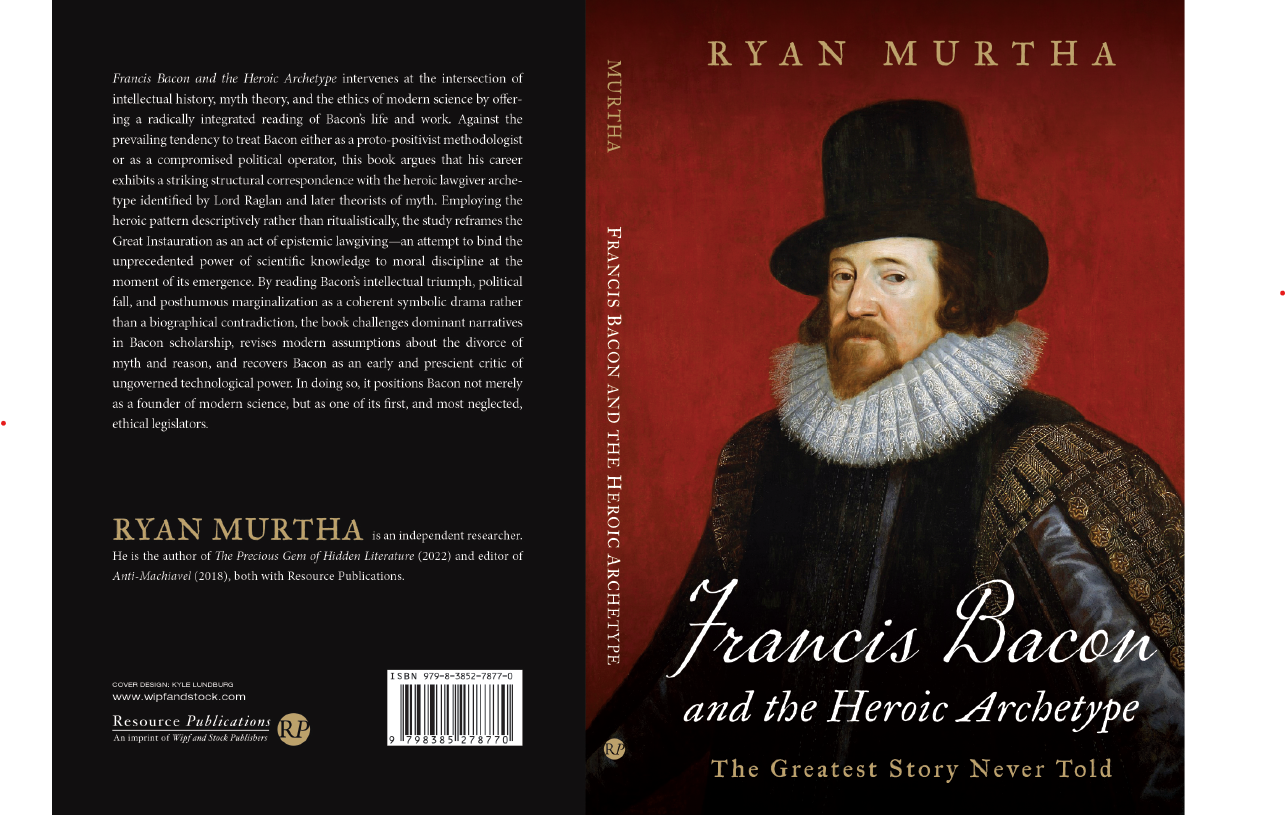
I have a new book coming out
Abstract
This book offers a mythological, political, and philosophical interpretation of the life and work of Francis Bacon, arguing that his career exhibits a striking structural correspondence with the heroic archetype as described by Lord Raglan and later theorists of myth. The heroic pattern is employed descriptively rather than dogmatically, as a heuristic for identifying recurring forms that emerge at moments of cultural, epistemic, and sovereign transition. Bacon’s life is read at two levels simultaneously: as a densely documented career embedded in the institutions of Elizabethan and Jacobean England, and as a symbolic drama through which deeper patterns of lawgiving, sacrifice, and renewal become visible.
Situating Bacon within a world of dynastic anxiety, theatrical sovereignty, and epistemic crisis, the book interprets the project of the Great Instauration as an act of lawgiving in the domain of knowledge. Bacon’s reform of method is treated as a non-violent heroic feat: a displacement of inherited intellectual authority and a reconstitution of legitimacy from tradition to disciplined inquiry. Particular attention is given to Bacon’s overthrow of Aristotelian scholasticism as a symbolic succession rather than a repudiation, and to his insistence that knowledge, precisely because of its power, must be morally governed.
The study further argues that Bacon’s political fall conforms to a familiar heroic logic: the lawgiver who renders visible the contradictions of a system becomes a site of expulsion and scapegoating, allowing institutional prestige to be preserved at personal cost. Bacon’s subsequent marginalization, especially through Victorian and positivist historiography, is read as a suppression of his mythic, moral, and allegorical dimensions in order to render him compatible with later narratives of scientific progress and imperial modernity.
Read through the lens of myth as symbolic disclosure, rather than fabrication, Bacon emerges as a tragic-heroic figure at the threshold of modern power: a founder whose method survived while his ethical architecture was quietly discarded. His unresolved legacy continues to shape contemporary debates about knowledge, power, and responsibility at a moment when technological capacity has once again outpaced moral restraint