Shakespeare’s childhood
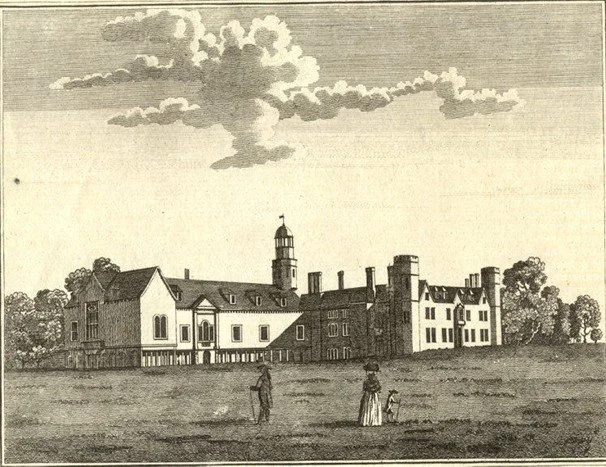
Gohambury House, Francs Bacon’s childhood home near St. Albans, Heretfordshire
“It is not my meaning to treat him as a ward: Such a word is far from my Motherly feeling for him. I mean to do him good.”
—Lady Anne Bacon in a letter to Anthony Bacon, 18 April 1593
Francis Bacon was raised in a household that stood at the nerve center of Elizabethan governance, learning, and reform. His father, Sir Nicholas Bacon, served as Lord Keeper of the Great Seal and was widely respected for his legal prudence, moderation, and commitment to institutional stability. Though not a grand stylist or visionary theorist, Sir Nicholas embodied the virtues of the Tudor civil servant: administrative competence, fidelity to the crown, and a belief that law was the principal instrument through which order could be maintained in a fragile post-Reformation polity. His career placed Francis, from infancy, within sight of the highest legal and political mechanisms of the realm.
Lady Anne Bacon, by contrast, brought into the household a formidable humanist and theological intensity. Anne Bacon, née Cooke, was among the most learned women in England; her father, Sir Anthony Cooke, had tutored Edward VI. Fluent in Latin, Greek, Italian, and French, she translated major Protestant theological works and maintained correspondence with leading reformers on the Continent. Her piety was rigorous, introspective, and morally exacting, shaped by the evangelical wing of the English Reformation. If Sir Nicholas represented the stabilizing force of law and office, Lady Anne represented the claims of conscience, scripture, and inward discipline. Francis thus grew up in a household where legal reason and moral seriousness were not opposed, but held in constant dialogue.
This domestic world was further intensified by its proximity to the household of William Cecil, Elizabeth I’s principal minister and the architect of much of her long and successful reign. Cecil was married to Lady Anne Bacon’s sister Mildred, herself a renowned scholar and patron of learning. Mildred Cecil shared her sister’s humanist education and religious seriousness, and the Cecil household became an extension of the Bacon domestic sphere, a kind of informal academy where politics, theology, classical learning, and statecraft intersected daily. The young Francis would have encountered there not only the rhetoric of power but its burdens: the necessity of prudence, concealment, patience, and compromise in service of the commonwealth.
The Cecil household, however, also exemplified a particular tension that would later shape Bacon’s thought. William Cecil was cautious, incremental, and deeply suspicious of novelty; his governing philosophy prized continuity and balance over systemic reform. Lady Anne Bacon’s moral absolutism, by contrast, could verge on severity, even toward her own sons. Francis grew up, therefore, between two powerful models of authority: one grounded in tradition and political survival, the other in inward truth and reformist zeal. His later ambition, to reform knowledge itself while remaining loyal to the state, can be read as an attempt to reconcile these inherited imperatives.
In this sense, Bacon’s early formation was not merely privileged but structurally charged. He was raised at the crossroads of law, religion, and governance, within families that effectively were the Elizabethan regime. The ideals and limitations of that world, its reverence for order and its fear of disorder, its moral earnestness and its resistance to radical change, formed the matrix against which Bacon would later define his own project. His call for a “Great Instauration” did not arise in opposition to the Tudor state, but from within its most intimate households, shaped by the very people who had built and sustained it.
If Elizabeth’s virginity functioned as a political technology, Francis Bacon’s instauration functions as its epistemic counterpart: a deliberate attempt to remake the foundations of knowledge itself. Long before the Novum Organum (1620) formally announced the overthrow of Aristotle’s Organon, Bacon conceived what he would later call the Great Instauration: a total reform of learning, method, and the uses of human understanding. As Macaulay observed, “His gigantic scheme of philosophical reform is said by some writers to have been planned before he was fifteen, and was undoubtedly planned while he was still young.”
In terms of heroic myth, this precocity matters. In Lord Raglan’s canonical pattern, the hero’s decisive act is a victory over the king, a giant, dragon, or wild beast, a symbolic defeat of an overgrown, tyrannical power. For Bacon, that adversary would be Aristotle himself: the senex ruler of the intellect, whose authority had ossified into scholastic domination. Raglan also notes, almost as a rule, that we are told nothing of the hero’s childhood. Here the pattern fits imperfectly but suggestively. Bacon’s early years are not entirely unknown, yet the surviving record is strikingly thin, especially in the treatment of his childhood by his great Victorian editor and biographer James Spedding. Spedding is notoriously brief on the formative interior life of the boy; what we possess are outlines rather than narratives, enough to suggest early exceptionalism, but not enough to domesticate it. The effect is archetypal: Bacon appears early as a mind already oriented beyond ordinary development, with no richly detailed childhood to anchor him securely within the common run of men.
One emblem of this precocity is the famous miniature by Nicholas Hilliard, painted when Bacon was seventeen or eighteen. Around the oval runs a Latin inscription usually rendered: Si tabula daretur, animum mallem—”If only I could paint his mind.” The phrase is extraordinary. It presents the young Bacon not as a court ornament or dynastic heir, but as an intellect already exceeding representation. In heroic terms, it marks him as inwardly “other,” defined less by lineage than by a latent, almost dangerous capacity.
That capacity was cultivated early. Bacon was sent to Trinity College, Cambridge, at the age of twelve, together with his elder brother Anthony Bacon, who would later play a crucial role in European intelligence networks. In the 1665 book Statesmen and Favourites of England since the Reformation, David Lloyd said of Francis that “At twelve his industry was above the capacity and his mind beyond the reach of his contemporaries.” Macaulay’s phrase, that Bacon possessed “the most exquisitely constructed intellect that has ever been bestowed upon any of the children of men” suggests something more specific and more structural than raw talent alone. An “exquisitely constructed” intellect is not merely powerful; it is formed, shaped, assembled with unusual care. The metaphor implies architecture rather than accident, design rather than spontaneity.
What formed Bacon was not simply “a good education,” nor even extraordinary intelligence, but a configuration of pressures, intellectual, moral, political, and psychological, that is no longer available, and in many respects should not be. Bacon was shaped in a world that placed enormous demands on children of the governing elite. Expectation was relentless; moral scrutiny was intense; failure carried real consequences not only for oneself but for one’s family and nation. He absorbed law, theology, rhetoric, and politics, not as optional attainments but as matters of survival and duty. The early modern household, especially one so close to power, did not distinguish sharply between childhood and preparation for adult responsibility. Formation began early because it had to.
Cambridge proved decisive not because it satisfied Bacon, but because it disappointed him. There, still a child, he encountered Aristotelian scholasticism in its late, arid form; a system he would later describe as having “done more harm than good,” and whose methods he believed actively obstructed the advancement of knowledge. The seeds of the future rebellion were planted not in ignorance, but in premature overexposure to an authority he already judged inadequate.
When Bacon went up to Cambridge, he entered not simply a university but a contested intellectual arena, one in which humanist learning, scholastic tradition, and emerging reformist energies coexisted uneasily. One of his early tutors was John Whitgift, later Archbishop of Canterbury, a figure emblematic of institutional discipline and doctrinal order. Whitgift was a rigorous logician and a staunch defender of ecclesiastical authority, deeply committed to the preservation of order against both Puritan radicalism and intellectual novelty. Under such tutors, Bacon would have received a demanding training in dialectic and disputation, precisely the methods he would later criticize as sterile when treated as ends in themselves. The experience seems to have sharpened his sense that education could be simultaneously exacting and misdirected: powerful in form, yet deficient in its orientation toward discovery.
More broadly, Bacon encountered at Cambridge a pedagogy still dominated by formal disputation and commentary, where Aristotle was not merely studied but institutionalized as an authority. Lectures were conducted in Latin; intellectual progress was measured by agility in syllogism, rather than by engagement with nature. Bacon’s dissatisfaction with this regime, formed not in ignorance but in intimate exposure, was therefore experiential rather than abstract. He did not reject scholasticism from the outside; he endured it, mastered it, and found it wanting. The seeds of his later insistence on method, experiment, and the reform of learning were planted precisely in this environment, where intellectual energy was abundant but systematically misapplied.
Taken together, the presence of figures like Whitgift and Harvey underscores that Bacon’s Cambridge years were not barren or merely repressive. They were formative in a more paradoxical sense. He was trained by men of formidable intellect and authority, exposed to new vocabularies of mind and self, and initiated into the institutional habits of learned culture. What emerged from this was not rebellion for its own sake, but a conviction that learning required re-founding at the level of its aims. Cambridge did not give Bacon his mature philosophy, but it gave him, early and decisively, the sense that the existing order of knowledge, however disciplined, had reached a point of exhaustion.
After leaving Cambridge in 1576, Bacon was sent to France as part of the English embassy under Amyas Paulet. This period, often treated as merely preparatory, is in fact crucial. Moving through the courts of France while still a teenager, Bacon absorbed continental politics, diplomacy, and most importantly, secrecy. It was during this time that he devised what he later called his biliteral cipher: a method of encoding a secondary message within an innocuous primary text by using two subtly different typefaces or letter forms, conventionally labeled “A” and “B.” Any visible text could thus carry a hidden message readable only by those who knew the key.
Technically speaking, this was the first explicit binary system for encoding information: meaning reduced to a sequence of dual oppositions, long before modern computation. Symbolically, it is hard to imagine a more Baconian invention. Knowledge is no longer a matter of inherited authority or surface appearance, but of method, structure, and decoding. Even as a youth, Bacon was already practicing the logic of the Novum Organum: the replacement of verbal tradition with operational technique. In heroic-archetypal terms, the future dragon-slayer is already forging his weapon.
Seen this way, Bacon’s instauration does not emerge suddenly in middle age. It unfolds as the life-long working-out of a heroic vocation formed under a virgin polity, directed against an ancient intellectual monarchy, and announced early through signs of precocity, displacement, and symbolic invention. The child is not fully visible, but the hero’s task already is.
France offered a living demonstration of political authority under strain, played out before the eyes of Europe at Blois. The Estates-General of 1576–77, summoned by Henri III amid civil war and fiscal collapse, was the first such assembly since 1560–61, and it met not as a ceremonial relic but as a crisis parliament. Convened at the Château de Blois, it brought together clergy, nobility, and Third Estate to negotiate money, policy, and legitimacy at a moment when the crown could no longer command unquestioned obedience. The monarchy was not overthrown, nor constitutionally transformed, yet it was unmistakably exposed. Subsidies were refused, grievances formally aired, and royal authority subjected to bargaining in full public view. The Estates made visible what theory often obscures: that sovereignty, when stripped of inherited awe, depends on consent, performance, and persuasion.
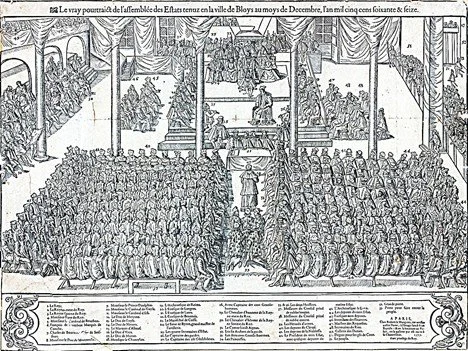
Estates-General of 1576-7
Bacon was present at exactly the moment when monarchy was compelled to negotiate with collective power, and he witnessed politics conducted not as abstraction but as theatre: procession, ritual, grievance, and refusal staged with deliberate solemnity. The lesson aligns uncannily with his later career. When he returned to England, he returned having seen both how authority conceals itself, and how, under sufficient strain, it can be made to speak.
Bacon’s return to England in early 1579 was precipitated abruptly by the death of his father, Sir Nicholas Bacon. The event marked a decisive rupture. The elder Bacon’s death removed the material and institutional security on which his future had quietly depended. Instead of returning as a courtier-in-training eased into place by paternal authority, Bacon returned as a young man of extraordinary intellectual ambition suddenly exposed to precarity. The mythic pattern sharpens here: the hero re-enters his native realm not in triumph, but under constraint, stripped of protection, compelled to make his way by talent rather than by inheritance.
The immediate consequences were sobering. Bacon inherited little, fell into debt, and found himself compelled to pursue advancement through the law, the Inns of Court, and parliamentary service rather than through effortless patronage. Yet this enforced recalibration proved formative. As Neumann writes,
It is precisely the persecutions and dangers heaped upon him by the hateful father figure that make him a hero. The obstacles put in his way by the old patriarchal system become inner incentives to heroism, and, so far as the killing of the father is concerned, Rank is quite right when he says that “the heroism lies in overcoming the father, who instigated the hero’s exposure and set him the tasks.” It is equally right to say that the hero, “by solving the tasks which the father imposed with the intent to destroy him, develops from a dissatisfied son into a socially valuable reformer, and conqueror of man-eating monsters that ravage the countryside, an inventor, a founder of cities, and bringer of culture.” But only if we take the transpersonal background into account do we arrive at an interpretation which does justice to the hero as a maker of human history, and which sees in the hero myth a great prototypal event honored by all mankind.
The lessons absorbed abroad, about secrecy, persuasion, institutional weakness, and the performative nature of power, now had to be translated into survival. Bacon’s early legal training, his disciplined prose style, and his acute sensitivity to faction all belong to this period of compression, when intellect was forced into practical channels. What might otherwise have remained speculative became tactical.
From this point forward, the trajectory of Bacon’s life acquires its distinctive double aspect. On the surface, he advances slowly and often painfully through public office: barrister, parliamentarian, counselor, eventually attorney general, lord keeper, and lord chancellor. Beneath that visible ascent runs a parallel project, more radical and more enduring: the reconstruction of knowledge itself. The frustrations of court life, the spectacle of authority under strain witnessed in France, and the early shock of loss at home converge into a single conviction: that inherited systems, whether political or intellectual, had exhausted their authority and required renewal at the level of method. Bacon’s return, therefore, is not merely biographical. It is the moment when exile becomes vocation, and experience hardens into a lifelong program aimed not at power alone, but at the re-founding of how power knows, governs, and endures.