Socrates-Plato-Aristotle and John-Jesus-Paul (revised)
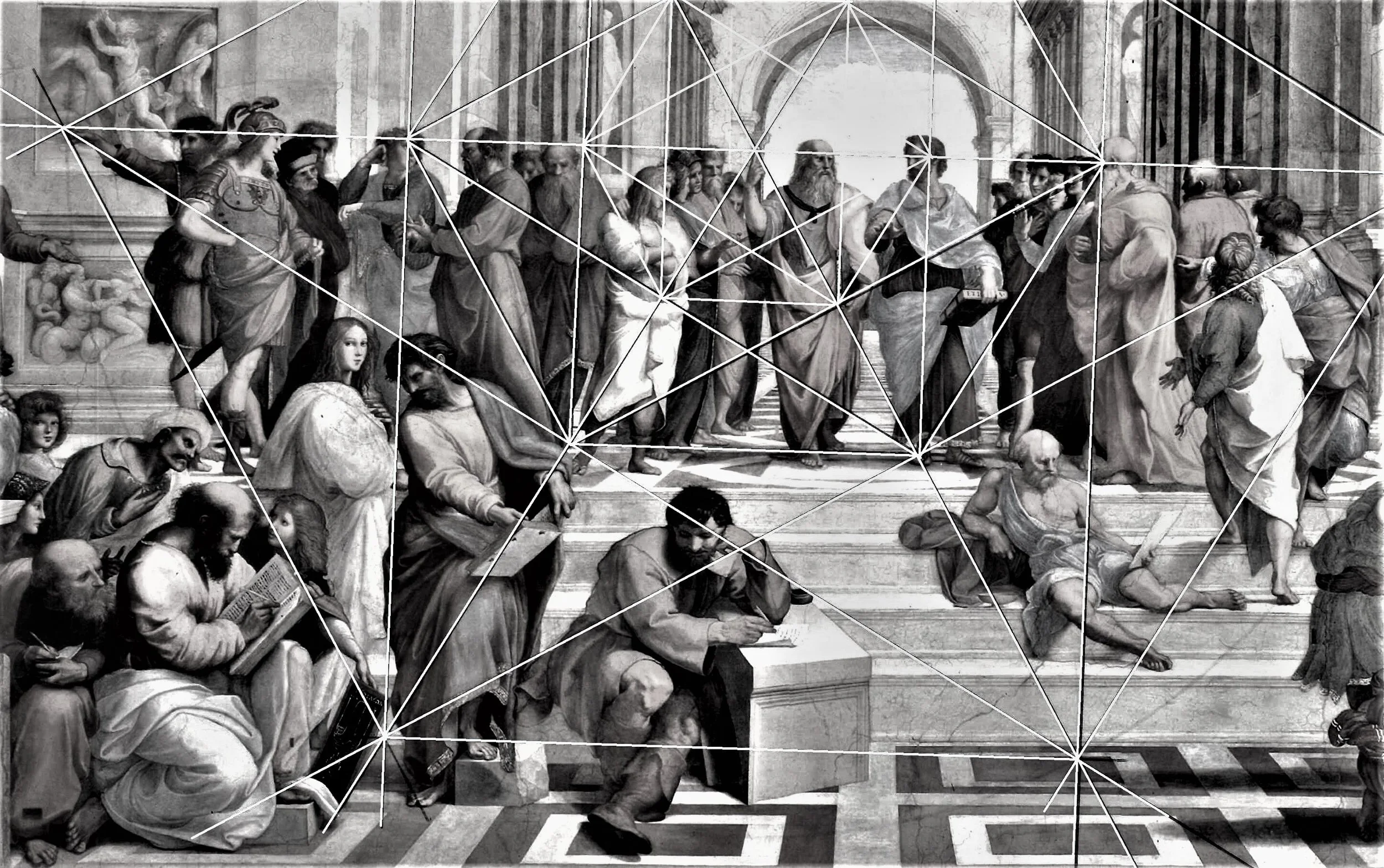
The Two Triads
A curious parallel joins the foundational succession of Greek philosophy to the formative succession of Christianity:
Socrates — Plato — Aristotle
John the Baptist — Jesus — Saint Paul
Each sequence begins with a disturbing public figure who stands outside ordinary respectability. Socrates wandered through Athens questioning politicians, poets, craftsmen, and young men, exposing the uncertainty hidden beneath conventional wisdom. He wrote nothing, possessed no formal school in the later institutional sense, and left his teaching in the memories of disciples. His appearance, poverty, irony, and indifference to social advancement gave him something of the holy fool. The city eventually condemned him as a corrupter and religious offender.
John the Baptist belongs to a still more visibly prophetic version of the same type. He appeared from the wilderness in rough clothing, living outside established society and summoning his hearers to repentance. He confronted religious complacency and political immorality with little concern for his own safety. Like Socrates, he left no writings. His teaching survives through those who came after him. Both men became troublesome voices of conscience, and both were executed by political authority.
They also occupy the position of the forerunner. Socrates prepared the philosophical field in which Plato’s thought would arise. John explicitly announced the approach of one greater than himself. Their work was unfinished by design. Each awakened the question that the succeeding figure would answer on a larger scale.
Plato and Jesus stand at the luminous center of the two sequences. Plato was repeatedly called “the divine Plato” in later antiquity and the Renaissance. The title expressed more than admiration for literary genius. His philosophy turned the soul toward eternal forms, the Good, immortality, judgment, purification, and ascent beyond the world of appearances. Socrates remained his master and principal dramatic voice, yet Plato transformed the Socratic encounter into an immense philosophical vision.
Jesus similarly receives the prophetic impulse of John and carries it into a new order of meaning. The call to repentance becomes the announcement of the Kingdom of God. The wilderness prophet gives way to the teacher who speaks in parables, gathers disciples, heals, confronts established authorities, and embodies the revelation he proclaims. Plato preserves and transfigures Socrates through philosophical drama; the Gospels preserve Jesus through sacred narrative. In both traditions, teaching survives through remembered conversations whose spoken immediacy becomes the foundation of a civilization.
The third figures give the teachings their durable argumentative and institutional reach. Aristotle converted the Platonic inheritance into an encyclopedic intellectual structure. He disputed, classified, distinguished, defined, and organized. Logic, metaphysics, ethics, politics, rhetoric, poetics, biology, psychology, and natural philosophy became parts of a vast architecture of knowledge.
Saint Paul performed a comparable work within early Christianity. His letters carry the meaning of Christ into disputes over law, grace, resurrection, Gentile membership, ecclesiastical order, moral conduct, spiritual gifts, and the nature of the emerging community. Paul’s argumentative energy is unmistakable. He reasons from Scripture, answers opponents, defines terms, rebukes congregations, distinguishes spirit from letter, and constructs the theological vocabulary through which much of later Christianity would understand Jesus.
Aristotle and Paul are therefore both great universalizers. Aristotle carried the Platonic-Socratic inheritance into systematic philosophy and the organization of knowledge. Paul carried the message of Jesus beyond its original Jewish setting and helped transform a local messianic movement into a universal religion. Each became indispensable to the later tradition, and each also became controversial for the degree to which the original inspiration was altered through systematization.
The parallel contains an important asymmetry. Plato personally knew Socrates, while Jesus followed John within the same prophetic world without becoming his literary interpreter. Aristotle studied directly under Plato, while Paul encountered Christ through conversion and revelation rather than through the earthly ministry. These differences keep the comparison from becoming mechanical. The value lies in the recurring sequence: the witness who awakens, the central figure who reveals, and the interpreter who organizes and carries the revelation into history.
The chronological relation adds another suggestive dimension. Socrates was executed in 399 BC, almost exactly four centuries before the traditional threshold of the Christian era. The public death of the philosopher therefore stands near the beginning of a four-hundred-year arc leading toward the birth of Christianity. Measured to the ministries of John and Jesus, the interval is somewhat longer—closer to four centuries and a generation—yet the larger historical rhythm remains striking. The Socratic revolution in consciousness precedes the Christian revolution by approximately one great civilizational cycle.
This may illuminate the older meaning of revolution as return. Christianity did not simply appear after Greek philosophy. It returned to many of its deepest questions within a new prophetic and religious form: the immortality of the soul, the relation between appearance and reality, the purification of desire, the authority of conscience, the meaning of the good life, the judgment of worldly power, and the willingness to die rather than betray truth.
Socrates’ death becomes especially important within this pattern. The philosopher accepts an unjust sentence and refuses escape because he will not destroy the laws that formed him. The Gospels later place another innocent teacher before political judgment. Both deaths expose the contradiction between lawful authority and justice. Both transform apparent defeat into a permanent moral victory. The condemned teacher becomes more powerful in memory than the state that condemned him.
The two triads might therefore represent successive stages in the formation of the Western mind. The Greek sequence established philosophical self-examination and rational inquiry. The Christian sequence interiorized the drama through conscience, faith, redemption, and universal spiritual community. Plato and Paul became the great textual bridges through which the voices of executed teachers entered history. Aristotle and Paul supplied structures capable of transmission across peoples and centuries.
This pattern belongs naturally in the larger argument of Notes Towards a New Paradigm. Intellectual history may contain recurring forms of transmission that disappear when philosophy and religion are studied in isolation. Placed beside one another, the Greek and Christian sequences begin to look like related movements within a longer history of consciousness: awakening, revelation, systematization, institutional inheritance, and eventual renewal.