Elizabeth I, the Virgin Queen
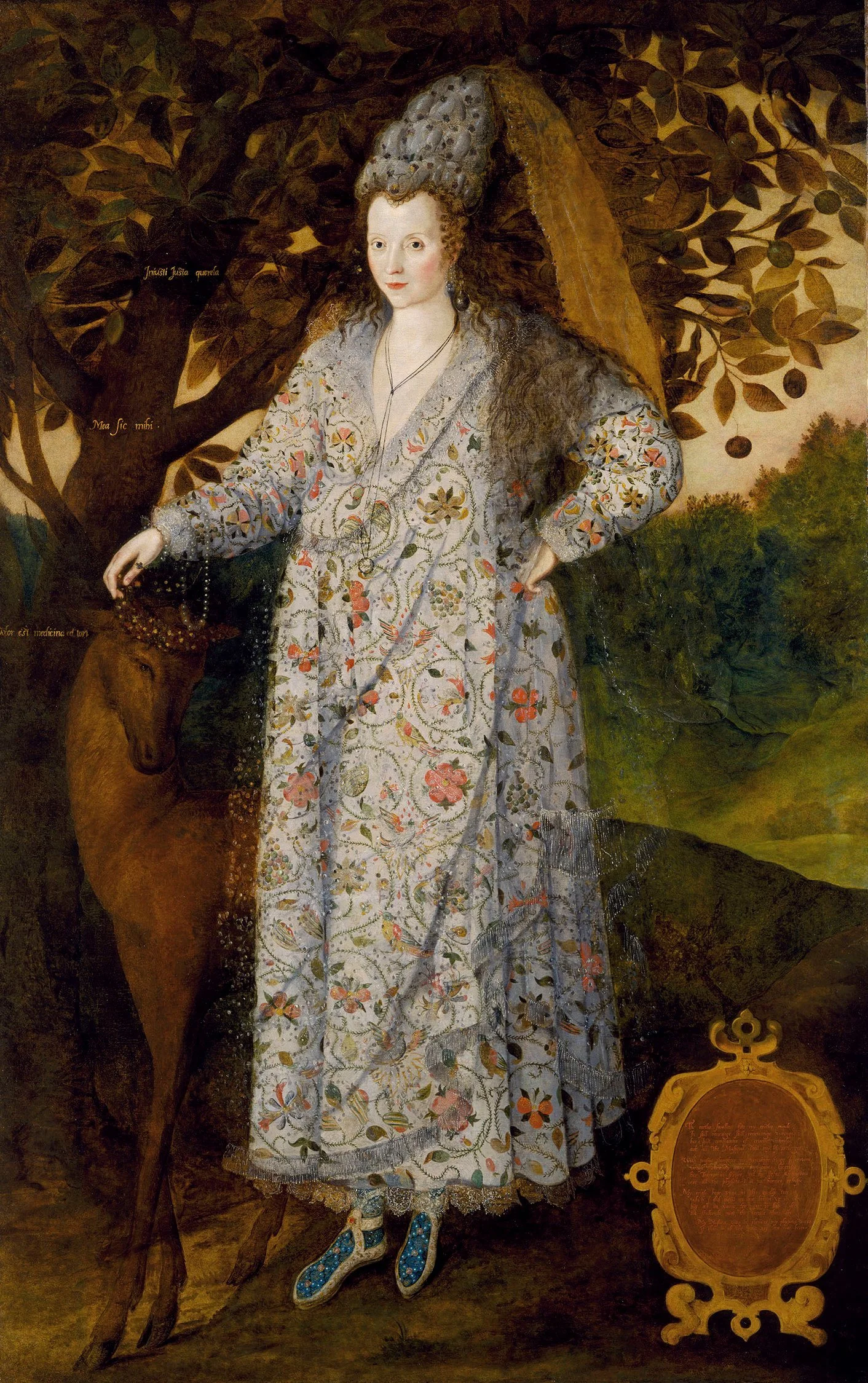
Pregnancy portrait of Elzabeth I,
Hampton Court Palace
History remembers Elizabeth I as the Virgin Queen, serenely detached from erotic entanglement and ruling through symbolic chastity. Diplomatic correspondence from the first years of her reign tells a markedly different story. Between 1559 and 1561, ambassadors from Spain, Venice, France, and England itself repeatedly reported an intimacy between Elizabeth and Robert Dudley so conspicuous that it generated rumors of marriage, pregnancy, and even homicide across Europe. These reports were not pamphlets or polemics, but private intelligence sent by senior diplomats to their sovereigns and councils, preserved today in the great editorial series known as the Calendar of State Papers, collections that summarize and translate original dispatches housed in archives at Simancas, Venice, Paris, and London.
Early testimony comes from Count de Feria, Philip II’s ambassador during the final months of Mary I and the opening of Elizabeth’s reign. Writing privately to Spain in April 1559, de Feria reported that Elizabeth’s attachment to Dudley was already notorious at court. In a dispatch dated 18 April 1559, he stated bluntly that “it is even said that her Majesty visits him in his chamber day and night.” De Feria was Catholic and hostile to Elizabeth, but he was a seasoned grandee, writing confidentially to his king, with no reason to invent behavior that could easily be contradicted by other diplomats in London.
This assessment was independently confirmed by Venice. Giovanni Michiel Schifanoya, reporting to the Venetian Senate on 10 May 1559, described Dudley as enjoying extraordinary favor and familiarity with the Queen. In the Calendar of State Papers Venetian, his words are rendered to the effect that “My Lord Robert is in very great favour and very intimate with Her Majesty.” Venice had no stake in English succession politics and no reason to echo Spanish hostility; Schifanoya’s report demonstrates that Elizabeth’s conduct was being noticed by neutral observers almost immediately after her accession.
From Paris, similar intelligence circulated through diplomatic networks. Giacomo Surian, writing in 1559, informed Venice that the Queen’s affection for Dudley appeared so decisive that foreign courts believed it would determine her marital future entirely. His dispatch is commonly translated as stating that “the love which Her Majesty bears to Milord Robert is so great that she will end by marrying him, or else marry no one.” Surian was not resident in London, but the significance of his report lies in how quickly the Dudley–Elizabeth relationship was being interpreted abroad as exclusive and potentially permanent.
A rumor that Elizabeth was pregnant bruited among the public; in August of 1560, one Anne Dowe of Brentwood, a sixty-eight-year-old widow, was jailed for speaking thus indiscreetly. Álvaro de la Quadra, Bishop of Aquila and successor to de Feria as Spain’s representative, reported that a trusted informant had told him Dudley had sent to poison his wife, adding that Elizabeth’s handling of marriage negotiations seemed designed to distract opposition until, as he put it, “this wicked deed” was accomplished. In early September, de Quadra met with William Cecil, Elizabeth’s chief counselor, and wrote of the encounter—
[Cecil] said that the Queen was going on so strangely that he was about to withdraw from her service . . . Lord Robert had made himself master of the business of the state and of the person of the Queen, to the extreme injury of the realm, with the intention of marrying her, and she herself was shutting herself up in the palace to the peril of her health and life. That the realm would tolerate the marriage, he said he did not believe . . . Last of all, he said that they were thinking of destroying Lord Robert’s wife. They had given out that she was ill, but she was not ill at all; she was very well and taking care not to be poisoned . . . Since writing the above, I hear the Queen has published the death of Robert’s wife.[1]
By the end of 1560, rumors of secret marriage and pregnancy were circulating so widely that even England’s own representatives were forced to address them. Nicholas Throckmorton, Elizabeth’s ambassador at the French court, wrote to William Cecil on 31 December 1560 that “the bruits of her doings be very strange in all courts and countries.” He reported that the Spanish ambassador in France had asked him directly whether the Queen was not already secretly married to Lord Robert—an inquiry Throckmorton neither confirmed nor dismissed, but which demonstrates how far such suspicions had spread.
De Quadra’s letters of January 1561 show that the crisis had not abated. Writing to Philip II on 22 January, he warned that if Elizabeth married Dudley without Spanish sanction, Philip had only to “give a hint” to her subjects and she would lose her throne. He described the Queen as “infatuated to a degree which would be a notable fault in any woman, much more in one of her exalted rank,” and reported that Dudley himself claimed a willingness to restore Catholicism if Philip would countenance the match. In the same letter, de Quadra added cautiously, “Some say she is a mother already, but this I do not believe,” a line that neatly captures both the intensity of the rumor and the diplomat’s own restraint.
Taken together, these dispatches form a coherent chronological record. From early 1559 through early 1561, multiple ambassadors independently observed or reported an intimacy between Elizabeth and Dudley that they believed had political consequences. The importance of this correspondence does not lie in proving marriage, pregnancy, or murder as historical facts, but in demonstrating how Elizabeth’s private conduct was perceived by contemporaries, and how urgently foreign powers believed it threatened the stability of the English succession.
The reason Elizabeth did not marry Robert Dudley was not lack of affection, but the political reality that such a marriage threatened the stability of her reign. Diplomatic correspondence makes clear that Dudley was widely detested, and for reasons that contemporaries understood perfectly well. He was the son of the Duke of Northumberland, the architect of the 1553 coup that placed Lady Jane Grey on the throne, and the Dudley name remained indelibly associated with treason, executions, and the near-collapse of the Tudor succession. The mysterious death of Dudley’s wife in 1560 made him politically radioactive; even unproven suspicion was sufficient to alienate nobles already predisposed to distrust him.
Beyond personal scandal lay deeper structural fears. A Dudley marriage would have meant the sudden dominance of a single court faction, the exclusion of rival noble houses, and a return to the hated politics of the royal favorite. Most dangerous of all was the succession question. A Dudley heir would inevitably be contested, potentially illegitimate in the eyes of large sections of the political nation, and capable of triggering the very civil war Elizabeth’s accession had narrowly avoided. When de Quadra warned Philip II in January 1561 that a Dudley marriage could cost Elizabeth her throne with only “a hint” to her subjects, he was not indulging in hyperbole. He was articulating a consensus shared across courts and councils alike.
The virgin mother in mythology
In The Origins and History of Consciousness, Erich Neumann describes the virgin mother as a liminal figure, standing between collapsing authority and emergent order:
The virgin mother, connected directly with the god who engenders the new order, but only indirectly with the husband, gives birth to the hero who is destined to bring that new order into being and destroy the old … The hero’s descent from the reigning family is symbolic of the struggle for the system of rulership, for that is what the struggle is really about.
This passage resonates uncannily with the Elizabethan situation. Elizabeth’s refusal to submit her body to a husband, English or foreign, was not a withdrawal from power, but a rechanneling of it. The “reigning family” here is not merely dynastic; it is the exhausted Tudor settlement itself, strained by multiple succession crises, factionalism, and the unresolved trauma of civil war. In Neumann’s terms, the virgin mother stands at precisely the moment when rulership must be reimagined rather than inherited in the ordinary way. Neumann goes further, emphasizing that the hero who emerges from such a matrix is almost always symbolically fatherless:
The essence of the mythological canon of the hero-redeemer is that he is fatherless or motherless, that one of the parents is often divine … mythology represents the hero as having two fathers: a personal father who does not count … and a heavenly father who is the father of the heroic part, of the higher man, who is ‘extraordinary’ and immortal.
What matters here is not literal genealogy, but legitimacy displaced upward. Authority is no longer grounded in an ordinary paternal line, but in a higher, impersonal source: God, destiny, history, or, in Elizabeth’s case, the body politic itself. When Elizabeth declared herself “married to the realm,” she was performing precisely this displacement.
Neumann is explicit that the term virgin must not be misunderstood in modern or moralistic terms:
These mothers are virgin mothers, which is not to say that what psychoanalysis has attempted to read into this fact is necessarily correct… virginity simply means not belonging to any man personally; virginity is in essence sacred, not because it is a state of physical inviolateness, but because it is a state of psychic openness to God.
This definition is crucial. Elizabeth’s virginity was not primarily anatomical; it was juridical and symbolic. She belonged to no man, no faction, no foreign prince. That “psychic openness” Neumann describes maps cleanly onto Elizabeth’s insistence that her authority derived directly from God and from England as a corporate body, not from a husband who might subsume or redirect it.
The pregnancy portrait at Hampton Court
Among the more unsettling images from Elizabeth’s reign is an allegorical pregnancy portrait now at Hampton Court Palace. The Queen appears in the guise of Diana, accompanied by a stag. Elizabeth was repeatedly identified with Diana, the virgin goddess of chastity and sovereign power over nature. Court poets and artists returned to this figure frequently, for Diana allowed Elizabeth’s unmarried state to be transfigured into divine authority.
The presence of the stag complicates the image. The stag unmistakably invokes the myth of Actaeon, the hunter who accidentally glimpses Diana naked and is punished by being transformed into a stag, torn apart by his own hounds. He represents the man who sees too much, who intrudes upon forbidden knowledge, who crosses the invisible line between reverence and presumption. To pair Elizabeth-as-Diana with Actaeon is to encode a warning: there are things at court that must not be looked at directly, questions that cannot be asked without consequence.
The portrait’s unease is heightened by its history. Like many images of Elizabeth, it shows signs of reworking and overpainting. Details have been softened or obscured, though no surviving evidence allows the original composition to be reconstructed with certainty. What remains is an image saturated with anxiety.
This logic, power maintained through controlled visibility, finds a striking parallel in Francis Bacon’s treatment of the Actaeon myth in Wisdom of the Ancients. Bacon does not read Actaeon as a moral tale about prurience; he reads it as a parable of political danger. Actaeon, he suggests, represents the courtier or statesman who hunts after the secrets of princes, who grows too curious about hidden counsels. Once transformed into a stag, such a man becomes exposed and vulnerable, no longer master of events but prey to them. The hounds that destroy him are not external enemies, but his own thoughts, anxieties, and disclosures, which turn upon him once he has crossed the fatal threshold of knowledge.
In Bacon’s reading, Actaeon is destroyed not for moral corruption but for epistemic transgression. He sees what cannot be safely seen and knows what cannot be safely known. The myth reveals a world in which truth is not denied, but displaced, forced into allegory, where it can be contemplated indirectly without being spoken. Power depends not merely on secrecy, but on the careful staging of secrecy: on making the boundary visible while keeping what lies beyond it hidden. This insight is not incidental to Bacon’s life. It is the key to understanding it.
Hamlet and Queen Elizabeth
Otto Rank mentions Hamlet as an example of the heroic archetype: “The fable of Shakespeare’s Hamlet also permits of a similar interpretation… mythological investigators bring the Hamlet legend from entirely different viewpoints into the correlation of the circle of myths.” Rank’s remarks on Hamlet are of interest:
It seems to me not improbable that the inspired poet portrayed himself in the Danish prince, so that he might with impunity utter high treason . . . the participation of Hamlet in his entrapping play might be explained from the fact that powerful opponents of Elizabeth did really use the poet as a means to attack her and stir her conscience. In this case, we should have a reflection, in Hamlet’s editing of the “play,” of the part important friends of the poet actually had in his work.[1]
Rank voiced doubts over the attribution of the canon: “we know so little of his actual life and even doubt his authorship. Shakespeare’s work and the biographical material that has been gathered about the Stratford butcher’s son have just as much psychological connection as have the Homeric poems and our scanty information about the blind Ionian singer.”[2]
Hamlet enters print in the early Jacobean moment, immediately after the death of Elizabeth in 1603. During her lifetime, Elizabeth was not merely a monarch but a sacralized political symbol: the Virgin Queen, the body politic itself, the “Great Mother” of England. To stage a tragedy in which the queen-mother is morally compromised, sexually suspect, and implicated in the corruption of the realm would have been extraordinarily sensitive while Elizabeth lived. After her death, that symbolic restraint loosens.
Read in that light, Gertrude’s sudden centrality in Hamlet is striking. She is not a passive background figure; the moral problem of the play runs through her body. Hamlet’s revulsion is not primarily directed at Claudius’s crime (regicide is almost taken for granted in revenge tragedy), but at Gertrude’s remarriage, her sexuality, her apparent lack of discernment, her failure to mourn “with the constancy of nature.” This aligns uncannily with long-suppressed cultural anxieties surrounding Elizabeth: her refusal to marry, the obsessive scrutiny of her body, rumors of illicit intimacy (Leicester, Essex), and the sense that the fate of the realm was bound to the queen’s sexual and maternal status. Gertrude becomes, in effect, the dramatized site where those anxieties can finally be spoken.
What makes the parallel sharper is that Hamlet is not an allegory of succession politics in the abstract; it is a meditation on a realm poisoned at its maternal source. Denmark is “an unweeded garden” not simply because a king was murdered, but because the queen’s desire has short-circuited lawful order. That emphasis resonates with post-Elizabethan retrospection: once the Virgin Queen is gone, her symbolic immunity evaporates, and the culture can begin to re-imagine the maternal sovereign as fallible, opaque, even culpable. Gertrude is not Elizabeth as she was, but Elizabeth as she could now be thought, no longer protected by living majesty.
This also explains why Hamlet is so uniquely modern: he is the son of a mythic political mother, suddenly forced to see her as human, sexual, compromised. That psychic rupture mirrors England’s own transition from the long Elizabethan stasis into the uncertain Jacobean present. The play’s appearance after Elizabeth’s death is therefore not merely chronological convenience; it marks a release. The maternal body of the state can finally be interrogated, and the cost of that interrogation—melancholy, paralysis, moral hyper-consciousness—is dramatized in Hamlet himself.
Within this framework, Polonius stands out as the clearest historical analogue. His resemblance to William Cecil, Elizabeth’s principal counselor for four decades, is widely acknowledged, even within orthodox scholarship. Polonius’s habits of surveillance, his prolix moralizing, his use of children as political instruments, and his belief that stability is preserved through information control closely mirror Cecil’s governing style and reputation. Gertrude’s relation to Elizabeth, by contrast, is less biographical than symbolic. She represents Elizabeth not as a person, but as a problem of sovereignty: a queen whose body, marriage, and sexuality are inseparable from the fate of the state.
Although Hamlet enters the historical record in print only in 1603, the evidence is overwhelming that it circulated in manuscript for several years before the death of Elizabeth. The so-called “Bad Quarto” of 1603 (Q1), far from being an embarrassment, is the clearest proof of this pre-1603 life. Its shortened length, paraphrased speeches, rearranged scenes, and simplified language are characteristic of memorial reconstruction, most plausibly by an actor who had performed the play repeatedly. A text of this kind presupposes an already established performance history: lines spoken often enough to be half-remembered, scenes vivid enough to be recalled in outline, but not yet fixed in authoritative literary form. In other words, Hamlet did not suddenly appear after Elizabeth’s death; it had already been living on the stage during her final years, circulating orally and theatrically rather than textually.
This chronology is crucial for interpretation. During Elizabeth’s lifetime, the play seems to have existed in a state of deliberate instability, performed publicly but not fully released into print. Only after her death in March 1603 does Hamlet break into textual circulation, first in damaged form (Q1), then in the expansive and philosophically dense second quarto of 1604–05. Such a sequence strongly suggests political and symbolic constraint. A tragedy centrally preoccupied with a morally compromised queen-mother, her sexuality, her remarriage, and her implication in the sickness of the body politic would have been extraordinarily sensitive while the Virgin Queen herself still embodied the state. The play could be performed, absorbed as drama, but not yet fixed, authorized, or stabilized as text. Once Elizabeth was gone, that restraint loosened. The maternal figure at the heart of the realm could finally be interrogated, and Hamlet could emerge fully into print. This historical pattern strengthens the case for reading Gertrude not as a casual character flaw, but as a dramatized site where long-suppressed anxieties about Elizabeth’s body, authority, and symbolic motherhood could at last be explored.
[1] Rank, Otto. The Myth of the Birth of the Hero and Other Writings. New York: Vintage 1959 p. 237
[2] Ibid., p. 199
[1] Letter to the Duchess of Parma, dated 11 September 1560