Shakespeare, Francis Bacon, and the Law
All those which have written of laws, have written either as philosophers or as lawyers, and never as statesmen. As for the philosophers, they make imaginary laws for imaginary commonwealths, and their discourses are as the stars, which give little light because they are so high. For the lawyers, they write according to the states where they live, what is received law, and not what ought to be law; for the wisdom of a law-maker is one and of a lawyer is another.
—Francis Bacon, Advancement of Learning
In heroic myth, lawgiving is not bureaucratic legislation, but a cosmological act: the hero articulates the principles by which chaos is restrained and the future made possible. In this sense, Bacon stands closer to Solon or Lycurgus than to any ordinary jurist. His legal reforms, his moral essays, and above all his attempt to legislate the conduct of the human intellect, together form a single lawgiving gesture, one aimed not merely at England, but at civilization itself. In a sense, they are of a piece:
Bacon’s procedures in natural philosophy were adapted by him from procedures in English law. Specifically, certain procedures in legal investigation and court trials, when linked with Bacon’s own proposals for legal reform, not only exactly parallel his procedure for a reformed natural philosophy, but they were the model for it.[1]
Francis Bacon’s role as a lawgiver begins not in metaphor, but in practice. Trained at Gray’s Inn and rising through the highest legal offices of the realm—Solicitor General, Attorney General, and finally Lord Chancellor—Bacon approached the law not as a mere technician but as a reformer concerned with foundations, coherence, and moral purpose. His legal writings, many of them circulated in manuscript rather than print, repeatedly seek to clarify, systematize, and rationalize the English common law, stripping it of obscurity, redundancy, and arbitrary custom. In this respect Bacon stands closer to the classical lawgiver than to the routine jurist: his ambition was not simply to argue cases, but to understand law as an ordered system capable of improvement. As Daniel R. Coquillette observes, “Bacon was the first truly analytical and critical jurist in the Anglo-American tradition. He was also the first to dare to apply an empirical, inductive analysis to lawmaking.” This judgment captures Bacon’s distinctive position: he brought to law the same reforming intelligence he would later bring to natural philosophy, treating legal institutions as human constructs subject to analysis, testing, and correction.
“Laws are made to guard the rights of the people, not to feed the lawyers. The laws should be read by all, known to all. Put them into shape, inform them with philosophy, reduce them in bulk, give them into every man’s hand.”
—Francis Bacon, speech in the House of Commons on 26th February 1593
Bacon’s tenure as Lord Chancellor reinforces this heroic-lawgiver profile. Contrary to later caricatures of the Court of Chancery as dilatory and labyrinthine, Bacon sought to accelerate equity proceedings, regularize procedure, and align legal judgment with moral intention rather than technical evasion. Under his administration, contemporaries noted that Chancery became so efficient it began drawing cases away from the common law courts, an innovation that earned Bacon both admiration and resentment. This pattern, too, is archetypal. In Raglan’s formulation, the lawgiver frequently provokes opposition precisely because he restrains entrenched interests and unsettles habitual disorder. Like Solon or Lycurgus, Bacon’s authority derived not from force or charisma, but from wisdom applied to chaos, and his reforms were aimed less at innovation than at stabilization.
The heroic lawgiver, in Lord Raglan’s sense, is not a technician of custom but a prescriber of foundations. He appears before crisis, not after it; his task is to articulate in advance the laws by which a society might avoid its own destruction. It is therefore a category error to judge such figures by the standards of professional administration or legal conformity. Francis Bacon repeatedly distinguished the wisdom of the law-maker from that of the lawyer, and understood his own vocation in the former, not the latter, sense. That this self-conception was neither idiosyncratic nor retrospectively imposed is confirmed by the historical record. As Hugh Trevor-Roper observed, the reforms later demanded with violence in the 1640s had already been set out, lucidly and loyally, a generation earlier—not by Coke, but by Bacon:
All the reforms of the law which would be loudly and angrily demanded by a rebellious people in the 1640s had been lucidly and loyally demanded, a generation before, not by Coke, but by Bacon. It was the same in education. Bacon, the greatest advocate of lay reason and lay religion, would have reformed the universities, dethroned Aristotle, introduced natural science; he would have stopped the growth of grammar schools and built up elementary education; he would have decentralised charitable foundations, whether schools or hospitals, for ‘I hold some number of hospitals with competent endowments will do far more good than one hospital of exorbitant greatness’; he would have decentralised religion, planting and watering it in the forgotten ‘corners of the realm’; and he would have decentralised industry, trade, wealth, for ‘money is like muck, not good except it be spread.’ When we read this evidence—evidence which is obvious, inescapable, constant throughout his writings—we can easily agree with the greatest of English seventeenth century historians, S.R. Gardiner, that if only Bacon's programme had been carried out, England would have escaped the Great Rebellion.[2]
When Bacon later remarked, in Latin, that he had foreseen civil disorder “on account of morals” (propter mores), he was not gesturing toward popular vice, doctrinal extremism, or abstract constitutional defect, but toward the visible corruption of governance at its center—a diagnosis already articulated, with remarkable consistency, in his essays “Of Counsel,” “Of Nobility,” and “Of Faction.” In “Of Counsel,” Bacon insists that stable rule depends upon structured, plural, and publicly intelligible deliberation; where access to the prince is monopolized by favourites, counsel degenerates into private confidence, and authority, however lawful in form, loses its moral visibility. “Of Nobility” develops the political consequences of this failure, locating the stability of monarchy in a respected and participatory aristocracy, and warning that the systematic bypassing of the nobility through personal intimacy, rather than public function, breeds resentment that is structural rather than personal. “Of Faction” completes the analysis, showing how such resentments, once normalized, detach loyalty from institutions and reattach it to persons, transforming private dependence into public division. Read together, these essays disclose a single causal chain: corrupted counsel produces alienation; alienation produces faction; faction, left uncorrected, produces civil conflict. Bacon’s claim to have foreseen rebellion “on account of morals” is therefore neither prophetic nor rhetorical, but administrative and ethical in the strictest sense; a judgment that the manners of power, long before the language of revolution emerged, had already made order untenable.
[1] Julian Martin, Francis Bacon, the State, and the Reform of Natural Philosophy 1992, Cambridge University Press
[2] Trevor-Roper, Hugh. Religion, the Reformation and Social Change, 1967, pp244-5
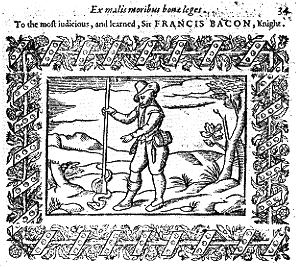
Minerva Britanna, 1612
This emblem from Minerva Britanna places Bacon squarely within what Lord Raglan identifies as the lawgiving phase of the heroic archetype. As Raglan observes, the hero of tradition is rarely remembered for administrative detail or political maneuvering; instead, “the only memorial of his reign… is the traditional code of laws which is often attributed to him,” even though such laws are in fact the product of long historical evolution rather than individual invention. The heroic lawgiver does not create order ex nihilo. Rather, he intervenes at a moment of crisis, codifies, purifies, and restrains forces already at work, and then recedes. Peacham’s shepherd, working not with sword or crown, but with measured incision, embodies precisely this function.
In the emblematic economy of Minerva Britanna, Bacon is figured as a modern analogue to the archaic lawgivers, above all Solon. The parallel is structural rather than rhetorical. Solon and Lycurgus impose foundational laws, refuse tyranny, withdraw or disappear, and leave their statutes to stand or fail without the prop of their continuing authority. They are remembered not for acts of rule but for acts of ordering. Bacon’s self-placement within this lineage is explicit and sustained. In A Proposition for Compiling and Amendment of Our Laws, presented to James I around 1616, Bacon invokes the ancient legislators to underscore a principle central to his own project: laws must outlive their author, and their authority must not depend upon personal rule or reputation…”the laws of Lycurgus, Solon, Minos… are not the worse because grammar scholars speak of them.”
That principle governs the substance of Bacon’s reform proposals. Far from advocating radical innovation, Bacon calls for a systematic restoration and reordering of English law, what he describes as “pruyning and grafting,” not uprooting. He diagnoses the causes of legal uncertainty with a jurist’s precision: an excessive accumulation of statutes, ambiguity of language, disorderly exposition, and contradictions among judgments.
Against this chaos he proposes clarity, certainty, and accessibility. Inspired by the model of Justinian, Bacon urges the creation of a concise legal “digest”: obsolete statutes removed, contradictions resolved, principles set out briefly but intelligibly, so that the law might be understood by ordinary subjects and not only by professional interpreters. In later documents—An Offer to the King of a Digest to be Made of the Laws of England (1621) and The Elements of the Common Laws of England—the same aim recurs: brevity without obscurity, clarity without prolixity, and institutions strong enough to function without continual personal intervention.
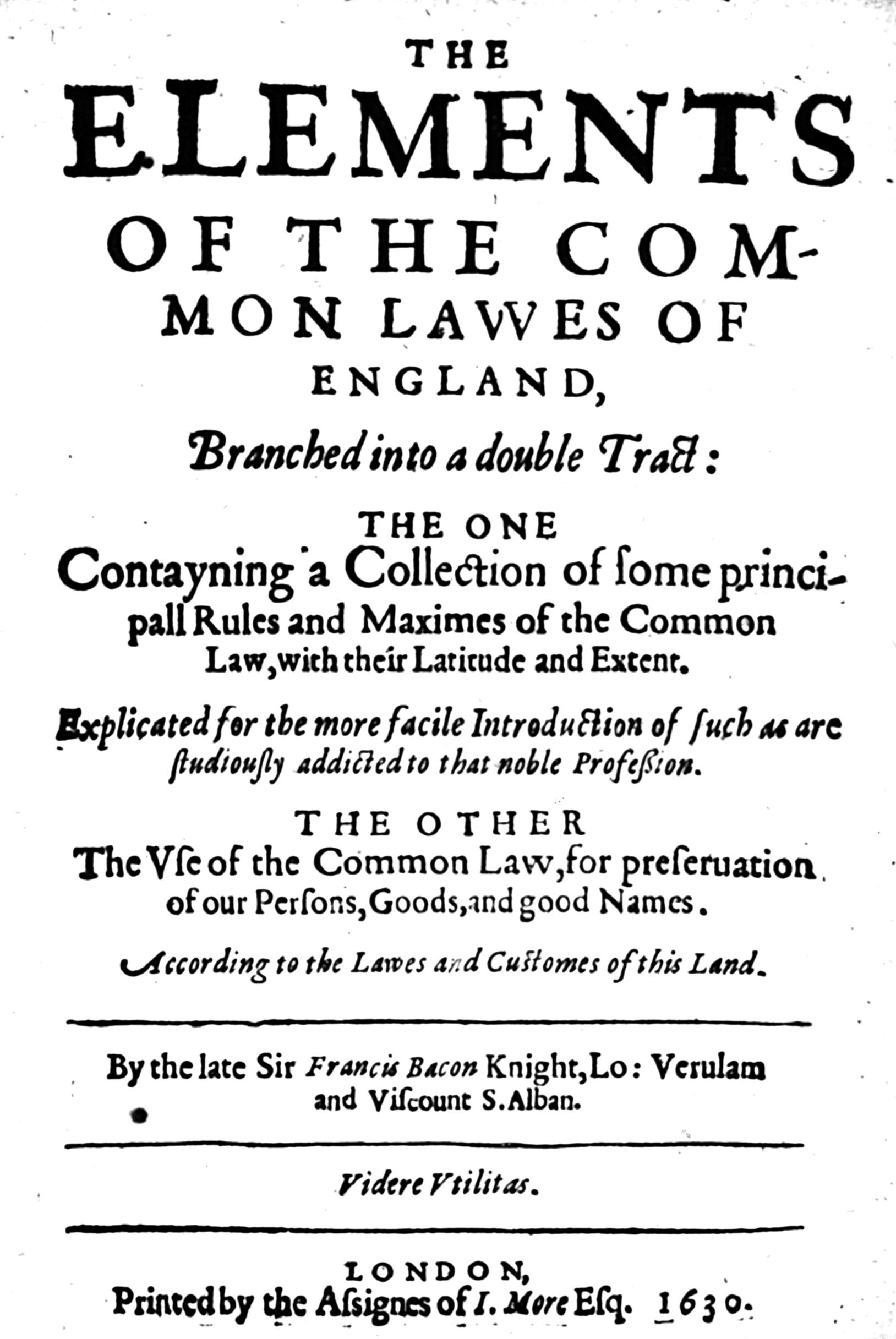
Francis Bacon’s Elements of the Common Laws of England, 1630
Yet Bacon’s most radical act of lawgiving occurs not in Westminster Hall but in the realm of knowledge itself, where the heroic pattern reaches its fullest expression. With the Novum Organum, Bacon does not merely propose a new scientific method; he promulgates a new constitution for the intellect. The work is saturated with legal metaphors that are neither casual nor decorative. Inquiry becomes a tribunal; nature is interrogated rather than speculated upon; conclusions are judgments rendered only after lawful procedure. The doctrine of the Idols functions as a sweeping repeal of corrupt statutes and illegitimate precedents that have governed human understanding: custom, authority, language, and theatrical philosophy standing in for entrenched but unlawful powers. True induction, by contrast, operates as due process: slow, cumulative, adversarial, and resistant to premature verdicts. Knowledge is no longer seized by brilliance or inspiration, but earned through obedience to law.
In Joseph Campbell’s terms, this moment corresponds to the hero’s “boon,” the gift brought back from the ordeal for the benefit of the community. Yet Bacon’s boon is distinctive. It is not a weapon, a secret, or a revelation, but a set of binding rules governing how truth itself may be sought. In this sense Bacon acts as a lawgiver in the strict Raglanian sense: he does not merely overthrow the old sovereign, Aristotle and the scholastic regime, but replaces it with binding norms meant to outlast his own authority. Forms function like legal definitions; tables of exclusion resemble evidentiary rules; method itself becomes statute. This juridical structure is not incidental. Bacon had spent a lifetime observing how judgment fails, how power corrupts procedure, and how systems harden into tyranny unless periodically re-founded. Novum Organum is thus best read as an act of epistemic legislation, binding the intellect under law so that future freedom might be possible.
That Bacon understood himself in this heroic lawgiving role is confirmed by contemporary reception and by his own words. In Minerva Britanna he is explicitly aligned with Solon, the archetypal lawgiver whose authority rested on wisdom rather than force. A generation later, the first historian of the Royal Society would elevate the analogy further, casting Bacon as a scientific Moses: one who leads others to the borders of the promised land of knowledge, though he does not himself enter it. This, too, follows the heroic pattern precisely: the lawgiver prepares the way, establishes the covenant, and withdraws, leaving the future to those bound by the laws he has given.
Most revealing of all is Bacon’s insistence upon moral limits to knowledge itself. In Valerius Terminus he pauses before opening the “fountain” of new learning in order to erect “a strong and sound head or bank to rule and guide the course of the waters.” Knowledge, he insists, must be “limited by religion, and referred to use and action,” and even the smallest portion granted to humanity under God’s “large charter” must remain subject to the benefit of society. This is not the voice of a Promethean rebel without restraint, but of a heroic legislator conscious that new power, intellectual as well as political, requires law lest it become destructive.
Taken together, Bacon’s legal reforms, his epistemic legislation, and his self-conscious alignment with classical and biblical lawgivers complete a coherent heroic pattern. Like the shepherd in Peacham’s emblem, Bacon confronts the serpent not to deny its danger, but to remove its sting; not to abolish human frailty, but to govern it wisely. In Raglan’s terms, he leaves behind not monuments or conquests, but laws. In Campbell’s, he brings back not fire alone, but the discipline to use it. Bacon’s claim to heroic lawgiving thus rests not on symbolism alone, but on a sustained attempt to reorder both justice and knowledge at their foundations, binding even his own intellect under laws he hoped would endure beyond him.
The earliest biography of Francis Bacon, written by his amanuensis and chaplain William Rawley, states that while Bacon became expert in the law, he preferred other studies in his youth:
Being returned from travel, he applied himself to the study of the common law, which he took upon him to be his profession; in which he obtained great excellency, though he made that (as himself said) but as an accessory, and not his principal study. He wrote several tractates upon that subject: wherein, though some great masters of the law did out-go him in bulk, and particularities of cases, yet in the science of the grounds and mysteries of the law he was exceeded by none.
A letter from Bacon to his uncle Lord Burghley (William Cecil) pleads for a position that will enable him to study other things than law:
Although it must be confessed that the request is rare and unaccustomed, yet if it be observed how few there be which fall in with the study of the common laws, either being well left or friended, or at their own free election, or forsaking likely success in other studies of more delight and no less preferment, or setting hand thereunto early without waste of years.
Poetaster (1601), a play written by Bacon’s friend Ben Jonson, portrays a character named Ovid Junior, a law student who spends his time reading poetry instead of studying law, upsetting his father:
Ovid Sr. Are these the fruits of all my travail and expenses? Is this the scope and aim of thy studies? Are these the hopeful courses wherewith I have so long flattered my expectation from thee? Verses? Poetry? Ovid, whom I thought to see the pleader [lawyer], become Ovid the play-maker?
Ovid Jr. No, sir.
Ovid Sr. Yes, sir; I hear of a tragedy of yours coming forth for the common players there, call’d Medea . . . What? shall I have my son a stager now?
Ovid Junior tells his father “I am not known upon the open stage: nor do I traffic in their theatres.” Medea is of course known for killing her own sons; this seems to be a pointed reference to Elizabeth.
The lawyer, when he reads attentively the works of William Shakespeare, may not be more surprised by the poet’s correct use of law terms, and intimate acquaintance with legal customs and tenures and the lex scripta, than by his extensive and profound knowledge of the maxims of the English law.
—William Lowes Rushton, Shakespeare’s Legal Maxims
Many writers have claimed that Shakespeare’s extensive and exact legal knowledge strongly suggests he was a lawyer; as Mark Twain put it in his book Is Shakespeare Dead? (1909):
Shakespeare couldn’t have written Shakespeare’s works, for the reason that the man who wrote them was limitlessly familiar with the laws, and the law-courts, and law-proceedings, and lawyer-talk, and lawyer-ways . . . a man can’t handle glibly and easily and comfortably and successfully the argot of a trade at which he has not personally served. He will make mistakes; he will not, and cannot, get the trade-phrasings precisely and exactly right; and the moment he departs, by even a shade, from a common trade-form, the reader who has served that trade will know the writer hasn’t.
A striking feature of Shakespeare’s engagement with law, most vividly in The Merchant of Venice and Measure for Measure, is that it operates not merely at the level of legal vocabulary or courtroom spectacle, but at the level of professional legal reasoning. Law in these plays functions as an internally coherent system whose logic, when pressed to its limits, produces both justice and catastrophe. This is precisely the level at which Francis Bacon theorized law. In his essay “Of Judicature,” Bacon repeatedly warns against the danger that rigid legality poses when severed from judgment, cautioning judges “that that which was meant for terror be not turned into rigor,” especially when “penal laws… have been sleepers of long.” The same concern appears even more pointedly in Bacon’s private counsel to Elizabeth, where he observes that “the cessation and abstinence to execute these unnecessary laws do mortify the execution of such as are wholesome.” Law neglected, Bacon insists, does not simply lapse; it corrodes the authority of law itself.
This exact anxiety is dramatized in Measure for Measure. Vienna’s ruler confesses that “We have strict statutes and most biting laws… / Which for this fourteen years we have let slip,” only to discover that sudden enforcement produces injustice rather than order. Shakespeare gives this problem a memorable image: “In time the rod becomes more mocked than feared.” The metaphor aligns perfectly with Bacon’s diagnosis. Law unenforced becomes contemptible; law enforced without discretion becomes cruel. The danger lies not in law itself, but in the oscillation between neglect and severity, a pattern Bacon feared would “mortify” even those statutes intended for the public good.
The affinity deepens in both writers’ treatment of equity and mercy. Bacon insists that no legal system can survive without equity, invoking the maxim summum jus, summa injuria (extreme law is extreme injustice) and reminding judges that their office is jus dicere, not jus dare: “to interpret law, and not to make law.” Mercy, for Bacon, is not sentimental indulgence but a judicial virtue exercised “as far as the law permitteth,” with “a merciful eye upon the person,” even while maintaining the force of legal example. This logic governs the trial scene in The Merchant of Venice. Portia does not defeat Shylock by overriding the law with compassion; she defeats him by embracing the bond absolutely and then interpreting it more strictly than its author anticipated. Mercy is praised: “The quality of mercy is not strained,” but the verdict itself turns entirely on construction, statute, and jurisdiction. Law is not suspended; it is turned back upon itself.
Taken together, these parallels do not prove common authorship. But they do establish a shared legal imagination, one deeply shaped by Inns of Court culture, in which law is simultaneously a civilizing necessity and a perilous abstraction. In Bacon’s essays and memoranda, and in Shakespeare’s plays, the same fear recurs: that law, when either forgotten or fetishized, ceases to protect and instead becomes a machinery of forfeiture, turning words into bonds and justice into sacrifice. The question, then, is not whether Shakespeare “knew some law,” but why the plays think like law under pressure, and why that thinking so closely resembles the legal philosophy articulated by Francis Bacon. What remains is not a verdict, but a record. And records, in law as in history, have a way of speaking for themselves.
The abstrusest elements of the common law are impressed into a disciplined service with every evidence of the right and knowledge of commanding. Over and over again, where such knowledge is unexampled in writers unlearned in the law, Shakespeare appears in perfect possession of it. In the law of real property, its rules of tenure and descents, its entails, its fines and recoveries, and their vouchers and double vouchers; in the procedure of the courts, the methods of bringing suits and of arrests, the nature of actions, the rules of pleading, the law of escapes, and of contempt of court; in the principles of evidence, both technical and philosophical; in the distinction between the temporal and spiritual tribunals; in the law of attainder and forfeiture; in the requisites of a valid marriage; in the presumption of legitimacy; in the learning of the law of prerogative; in the inalienable character of the crown, this mastership appears with surprising authority.
—Cushman K. Davis, The Law in Shakespeare