Terence McKenna
In my younger days I knew people interested in McKenna, but I never really got into him. Later, doing my research on alchemy, I read his book Food of the Gods and was startled to see this:
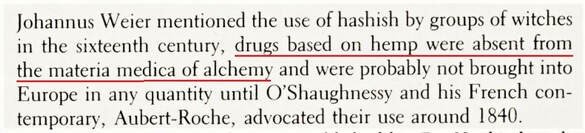
Nothing could be further from the truth, I am kind of shocked he even wrote this. Rabelais wrote all about cannabis in Gargantua and Pantagruel, one of the major French classics, and he used a lot of alchemical terminology. McKenna was recruited by Intelligence when he got busted for drugs in 1971:
So it turns out, Terence McKenna was another controlled opposition spook. I apologize to the spooks for all my ranting about them, but they are everywhere and they get really annoying. Academic writing on alchemy is dominated by a new thesis which was also likely commissioned by CIA. According to William Newman and Lawrence Principe, there was never any genuine mystical content in the alchemy corpus, all the bizarre language is just coded cant for real laboratory experiments. I have read a few academic scholars who rejected this premise, it’s ridiculous but that’s what the feds are going with. Yes, the CIA controls academia and book publishing, it’s not just Hollywood, it’s serious stuff too.
The pseudonym Basil Valentine, whose 1604 text they are discussing, alludes to the early Gnostic theologians Basilides and Valentinus. It is another Bacon coinage; he also wrote alchemy tracts under the name Eirenaeus Philalethes, alluding to Irenaeus of Lyons, whose book Against Heresies attacked the Valentinians and other Gnostic sects. I think by using these names, Bacon was trying to start a debate about gnosticism within modern Christianity, without risking too much by open discussion.
I debated whether it’s appropriate to write the truth about this stuff. The truth is that it’s dangerous and you’re probably better off with simple faith. But long before I was interested in God or philosophy, I believed in psychedelics, and I still do. There’s also the prophecy that the knowledge will be given out at the end of the age.
”Elias Artista — A Precursor of the Messiah in Natural Science” - Herbert Breger:
The history of Elias artista is the history of an almost forgotten utopian concept in natural science. The advent of the modern age brought with it a widespread belief amongst physicians and chemists, particularly in Germany, that God in a not too distant future would be sending a person, capable of revealing all nature’s secrets to humanity, that person being Elias artista. His disclosures were to coincide directly with the end of this iniquitous world and the beginning of a messianic age (a golden world or the millennium).
Paracelsus, Book Concerning the Tincture of Philosophers:
Nothing is concealed that shall not be revealed. There are many more secrets concerning the transmutation, though they are little known, for if they are revealed to someone their fame is not immediately common. With this art, the Lord bestows the wisdom to keep it secret until the advent of Elias Artist. Then shall be revealed what has been concealed.
Eirenaeus Philalethes, An Open Entrance to the Closed Palace of the King:
My Book is the precursor of Elias, designed to prepare the Royal way of the Master; and would to God that by its means all men might become adepts in our Art - for then gold, the great idol of mankind, would lose its value, and we should prize it only for its scientific teaching. Virtue would be loved for its own sake.
Walter Pagel, “The Paracelsian Elias Artista and the Alchemical Tradition”:
To Paracelsus Helias represents various features of an ideal through which enlightenment and happiness will descend upon future generations and lift the veil of obscurity which still blinds him and his age. Helias is the perfect adept to come . . . Paracelsus’s Helias artista with his messianic associations and the vision of a super-chemistry coming true in a distant future ties up with a strong mediaeval tradition.
Behold, I will send you Elijah the prophet before the coming of the great and dreadful day of the Lord…
At any rate, here is McKenna’s talk on alchemy, take it with a grain of salt, and some sulfur and mercury.